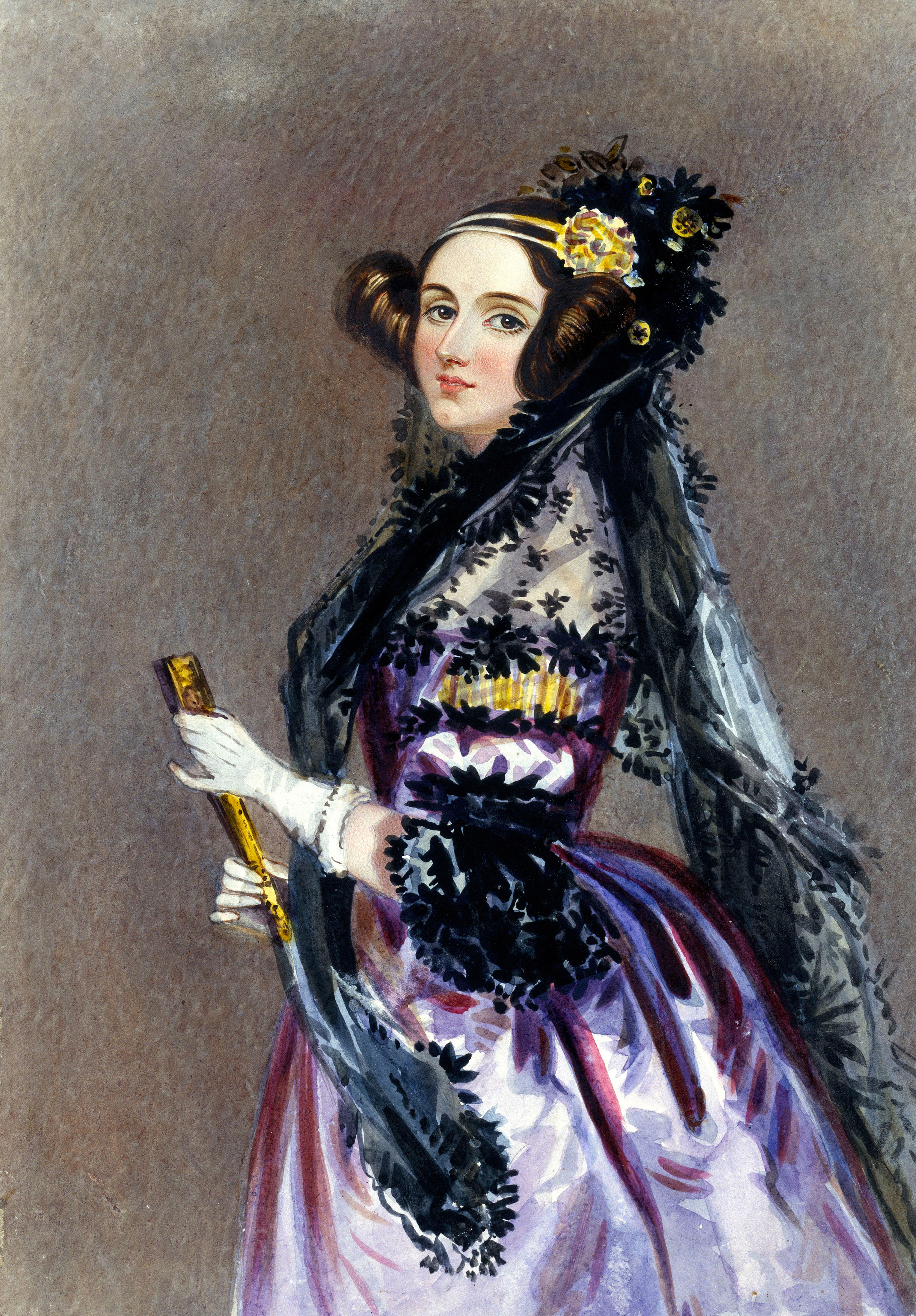
Ada Lovelace holds a distinctive place in the history of computing. Born
in 1815, more than a century before electronic computers, she studied a
machine that existed only in designs: Charles Babbage’s Analytical
Engine. She did more than explain how it might work. She imagined that
a programmable machine could manipulate symbols, generate music, and
carry out general sequences of operations.
That ability to see beyond arithmetic is why her name remains connected
to the origins of programming.
A childhood between poetry and mathematics
Augusta Ada Byron was born in London on 10 December 1815. She was the
daughter of the Romantic poet George Gordon Byron, known as Lord Byron,
and Anne Isabella Milbanke, whom Byron nicknamed his “Princess of
Parallelograms” because of her interest in mathematics.
Her parents’ marriage ended quickly. Ada barely knew her father, who
left England when she was still a baby and died in Greece in 1824.
Her mother arranged an unusually scientific education for a young
aristocratic woman in nineteenth-century Britain. Ada studied
mathematics, logic, music, and languages with private tutors. The
scientist Mary Somerville and the mathematician Augustus De Morgan were
among the people who influenced her education.
This training did not suppress her imagination. Instead, Ada tried to
connect mathematical discipline with poetic creativity. She later used
the expression poetical science to describe this approach.
Meeting Charles Babbage
Ada met Charles Babbage at a social gathering in June 1833. Babbage was
already known for designing mechanical machines intended to automate
calculation.
His first major project was the Difference
Engine, which was designed to
produce numerical tables automatically. When Ada saw a working section
of the machine, she immediately understood its significance. A lasting
intellectual friendship and correspondence developed between her and
Babbage.
Babbage later designed a far more ambitious system: the Analytical
Engine. Unlike the Difference
Engine, which was specialised for a particular family of calculations,
the Analytical Engine was intended to execute different sets of
instructions.
Its plans included several ideas familiar from modern computers:
- a memory called the “store”;
- a calculating unit called the “mill”;
- instructions supplied on punched
cards;
- repeated operations;
- the ability to alter the sequence of operations according to an
intermediate result.
The machine was never fully built during Babbage’s lifetime. Yet its
architecture raised a new question: what could be achieved with a
general machine able to follow a program?
Menabrea’s paper and the seven notes
In 1842, Italian engineer Luigi Federico Menabrea published a French
account of the Analytical Engine based on a lecture Babbage had given in
Turin.
Ada translated the paper into English. Encouraged by Babbage, she added
seven notes, labelled A to G. The notes were substantially longer than
the original article and appeared in 1843 under the initials A.A.L.
They were much more than editorial comments. Ada explained the machine’s
principles, compared its punched-card system with the Jacquard loom, and
explored possible applications.
She stated a crucial idea: if objects could be represented through
formal rules, the machine might manipulate them. Numbers did not have to
represent quantities alone. They could stand for musical notes, letters,
or other symbols.
This insight anticipated the general principle of digital information
processing.
Note G and the Bernoulli numbers
The final section, Note G, contains a table describing how the
Analytical Engine could calculate a sequence of Bernoulli numbers.
These numbers appear in several areas of mathematics. Automating their
calculation requires an exact order of operations, intermediate results,
and the reuse of stored values.
Ada’s table sets out:
- the variables involved;
- the order of operations;
- values retained in memory;
- the repetitions required;
- the movement of results between parts of the machine.
For that reason, it is often described as the first published computer
program intended for a general-purpose machine.
The claim needs context. Babbage had already written sequences of
operations for his Engine, but they were not published in the same form.
Their correspondence also shows close collaboration. Historians continue
to debate the exact contribution each person made to the table.
That debate does not diminish the importance of the notes. They remain
the first extensive published presentation of a program for the
Analytical Engine.
Was Ada Lovelace really the first programmer?
The title “first computer programmer” has become inseparable from Ada
Lovelace. It is useful, but it can suggest that she worked alone on an
operational machine. Neither point is accurate.
The Analytical Engine was never completed, so the algorithm was not run
on its intended hardware. Babbage had produced program examples of his
own and contributed to the work surrounding Note G.
On the other hand, describing Ada as merely a translator is equally
misleading. Her notes show an independent understanding of the Engine’s
possibilities. They connect mechanical operations to a broader view of
symbolic representation and programming.
A careful formulation is that Ada Lovelace authored the first
published algorithm for a programmable general-purpose machine, within
a close intellectual collaboration with Charles Babbage.
A vision beyond calculation
Ada’s most durable contribution may extend beyond the Bernoulli-number
table.
At the time, calculating machines were mainly seen as devices for
speeding up arithmetic. Ada understood that the Analytical Engine might
process anything that could be expressed through formal relationships.
She suggested, for example, that the machine could compose elaborate
pieces of music if the rules of harmony were properly represented.
This is close to the way digital systems work today. A computer does not
directly perceive a photograph, a song, or a text. It processes encoded
representations according to agreed conventions.
Ada also distinguished mechanical execution from the creation of rules.
A machine could carry out the operations provided to it, but it could
not spontaneously originate something that had not been specified. This
argument, later known as “Lady Lovelace’s objection,” was discussed by
Alan Turing more than a century later in his work on machine
intelligence.
A short life with broad ambitions
Ada married William King in 1835. When he became Earl of Lovelace in
1838, she became Countess of Lovelace. They had three children.
Despite social and family constraints, Ada continued her studies and
projects. She sought to deepen her mathematical knowledge and imagined
further scientific work. Her correspondence reveals both strong
intellectual ambition and periods of illness and personal difficulty.
She died on 27 November 1852 at the age of 36 after several months of
illness. At her request, she was buried near her father at the Church of
St Mary Magdalene in Hucknall, England.
Her work was then largely forgotten. The 1843 notes received renewed
attention only in the twentieth century, when electronic computers made
the significance of Babbage and Lovelace’s ideas easier to recognise.
A delayed recognition
In 1953, Ada’s notes were republished in a volume about digital
computing machines. Their meaning had changed: the programmable machine
she had studied now resembled, in principle, the computers being built
around the world.
Her name gradually became a symbol of computing history and of women’s
contributions to science.
The Ada programming language, developed from the late 1970s for the
United States Department of Defense, was named in her honour. It was
designed for systems where reliability matters, including aerospace,
transport, and industrial applications.
Ada Lovelace Day is held each year to celebrate the achievements of
women in science, technology, engineering, and mathematics.
Schools, buildings, awards, and research programmes also bear her name.
Why Ada Lovelace still matters
Ada Lovelace never used a modern computer. She never saw the Analytical
Engine operate. Yet her writing addresses several central ideas in
computing:
- the distinction between a general machine and the instructions it
follows;
- the symbolic representation of different kinds of information;
- the methodical organisation of an algorithm;
- repeated operations;
- the difference between a machine’s capabilities and the human
purpose directing its use.
Her story also demonstrates that major technological advances do not
depend only on completed machines. They can begin with a new
understanding of what a machine might become.
That may be her deepest legacy: Ada Lovelace looked at an unfinished
mechanical design and recognised the outline of a universal
information-processing tool.
Timeline
- 1815: Augusta Ada Byron is born in London.
- 1833: she first meets Charles Babbage and sees his calculating
machinery.
- 1835: she marries William King.
- 1838: she becomes Countess of Lovelace.
- 1842: Luigi Menabrea publishes his account of the Analytical
Engine.
- 1843: Ada’s translation and seven notes are published, including
the Bernoulli-number algorithm.
- 1852: Ada Lovelace dies at the age of 36.
- 1953: her notes are republished in the context of electronic
computing.
- 1980: the Ada programming language officially receives its name.
Frequently asked questions
Did Ada Lovelace invent the computer?
No. Charles Babbage designed the Analytical Engine. Ada Lovelace helped
explain its operation, formalised an algorithm intended for it, and
envisioned uses extending beyond numerical calculation.
Did her program actually run?
It was never executed on the Analytical Engine because the machine was
not completed. Historians and computer scientists have nevertheless
studied Note G to understand its intended operation and limitations.
Why call it a program if the machine did not exist?
A program is an organised set of instructions for a specified
architecture. It can be designed before the hardware is fully
constructed, just as software can now be written from a technical
specification.
What is Ada Lovelace’s main legacy?
Her legacy combines a published algorithm for a programmable machine
with a vision that computers could manipulate any kind of information
that can be represented symbolically.