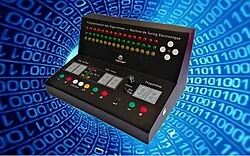
The Turing machine is one of the most important concepts in theoretical computer science. Yet it looks almost nothing like a modern computer: no screen, no processor, no keyboard and, in its theoretical form, not even a practical limit on its memory.
Imagined by Alan Turing in 1936, it answers a much more fundamental question: what is computation?
To answer it, Turing devised a deliberately minimal machine capable of reading and writing symbols on a tape while following a precise set of rules.
Despite its extreme simplicity, the model is powerful enough to represent any computation that can be carried out by an algorithm, according to the classical theory of computability.
The Turing machine is therefore much more than a historical curiosity. It helps us understand what an algorithm is, what a computer can theoretically compute and, above all, why some problems will remain impossible to solve automatically regardless of how powerful future machines become.
Why was it necessary to define computation?
At the beginning of the twentieth century, mathematicians were trying to formalize the foundations of their discipline.
An important question concerned the existence of systematic procedures for solving mathematical problems.
German mathematician David Hilbert notably formulated the Entscheidungsproblem, or “decision problem.”
In simplified terms, the question was: can we devise a mechanical procedure capable of determining, for any proposition expressed in a given logical system, whether it can be proved?
But this question hides another one.
What exactly does it mean to “follow a mechanical procedure”?
Today, we would naturally speak of an algorithm executed by a computer.
In 1936, however, the programmable electronic computer did not yet exist.
It was therefore necessary to define mathematically what a computational procedure is, independently of any real machine.
That is precisely what Alan Turing did.
To place this discovery in context, the biography of Alan Turing explores his work in logic, his role during the Second World War, and his contributions to early computers.
A deliberately simple machine
A classical Turing machine has only a few components:
a tape divided into cells;
a limited set of symbols;
a read-write head;
a finite set of states;
a table of transition rules.
At each step, the machine observes the symbol under its read head.
Depending on that symbol and its current state, a rule tells it what to do.
It can:
write a symbol in the current cell;
move its head one cell to the left or right;
change state;
eventually halt.
The process then repeats.
A sequence of extremely simple elementary actions can therefore produce a complex computation.
The tape: theoretically unlimited memory
The tape is generally represented as a long sequence of cells.
Each cell can contain a symbol belonging to an alphabet defined in advance.
In the classical theoretical model, the tape is considered large enough—often ideally unlimited—so that the machine never runs out of memory during the computation being studied.
This obviously does not mean that a real computer can have infinite memory.
The assumption separates two different questions:
is a problem theoretically computable?
do we have enough physical resources to carry out the computation in practice?
The Turing machine is primarily concerned with the first.
The read-write head
The head is the active part of the machine.
It examines only one cell of the tape at a time.
It can read the symbol in that cell, possibly replace it with another symbol, and then move.
This limitation is deliberate.
The machine does not need to observe the entire tape at once.
It works through a sequence of extremely simple local operations.
That minimalism is exactly what makes the model so useful: if such an elementary machine can represent highly complex computations, then computation itself can be studied independently of the technology used to build a computer.
States: the machine’s internal memory
In addition to the contents of the tape, the machine has a current state.
We can imagine states named:
q0, q1, q2, and so on.
The state indicates which phase of processing the machine is currently in.
A rule might say:
If the machine is in state q0 and reads the symbol 1, write 0, move right, and enter state q1.
Another rule describes what to do when the machine is in q1.
The complete behavior of the machine is therefore determined by three elements:
current state + symbol read + transition rule.
A simple example: adding 1 to a number
Let us use a deliberately simple representation.
Suppose an integer is written in unary notation: the number 4 is represented by four 1 symbols.
1111
We want to build a machine that adds 1.
Its program can be extremely simple:
while the head reads 1, move right;
when it reaches a blank cell, write 1;
halt.
The tape becomes:
11111
The machine has just computed:
4 + 1 = 5
Of course, no modern computer would perform addition this way.
Efficiency is not the point.
The example shows that a computation can be decomposed into a sequence of perfectly determined mechanical rules.
Is a Turing machine a real computer?
Not in the usual sense.
The Turing machine is primarily a mathematical object.
In 1936, Turing was not trying to propose an industrial blueprint for a computer to be manufactured.
He wanted a sufficiently precise model for reasoning about computable procedures.
Physical machines inspired by the model can be built for educational purposes, but that was not the original purpose of the concept.
This is an important difference from historical projects such as Charles Babbage’s Analytical Engine, which was conceived as an actual programmable mechanical machine.
From Babbage to Turing: two ways of thinking about a general machine
In the nineteenth century, Charles Babbage imagined the Analytical Engine as a device capable of carrying out different computations according to the instructions supplied to it.
Punched cards were intended, among other things, to represent operations and data.
Babbage approached the problem mainly as an engineer and inventor: how could a general machine be built to execute different calculations?
Turing asked a more abstract question:
what can a computing machine do in principle?
The two approaches are different, but they form part of the same intellectual evolution: progressively separating the physical machine from the instructions that determine its behavior.
The universal machine
One of Turing’s most powerful ideas is the universal machine.
Imagine several Turing machines.
The first performs addition.
A second compares two numbers.
A third carries out another procedure.
At first glance, each task might require its own machine and its own table of rules.
Turing showed, however, that a particular machine can receive on its tape:
the description of another machine;
the data on which that machine is supposed to operate.
It can then simulate the operation of the described machine.
This is the universal Turing machine.
One machine, many programs
This idea seems natural today because we use general-purpose computers every day.
The same computer can:
display a web page;
edit a photograph;
run a game;
process a CSV file;
compile code;
play a video.
We do not physically rebuild the computer for every task.
We change the program.
The idea of a universal machine formalizes precisely this separation between a device capable of computation and the description of the computation to be performed.
That is one reason Turing’s work occupies such an important place in the conceptual history of the computer.
Universal machine and von Neumann architecture are not the same thing
The universal Turing machine is sometimes directly equated with the architecture of modern computers.
That needs qualification.
The universal Turing machine is a mathematical model showing that one machine can simulate other machines when given their descriptions.
Von Neumann architecture, by contrast, describes a practical organization of electronic computers in which instructions and data can be stored in memory.
The two ideas clearly have an intellectual relationship: in both cases, the same physical machine can execute different programs.
But they serve different purposes.
Turing studies computability.
Von Neumann and the teams developing early electronic computers were concerned, among other things, with their architecture and practical implementation.
What is a computable problem?
Using his model, Turing could give precise meaning to computation.
In simplified terms, a problem is considered computable if a Turing machine exists that can produce the expected result by following a finite number of steps for the relevant inputs.
This definition turns an intuition—“there must be a method for solving this problem”—into a mathematical question.
Can a precise procedure be constructed?
Can it be described by mechanical rules?
Will the machine eventually produce an answer?
These questions lie at the heart of computability theory.
Not every problem is computable
One of Turing’s most important lessons is counterintuitive:
there are problems that no algorithm can solve in every case.
This is not a temporary limitation caused by the computers of the 1930s.
Nor is it a problem that will simply disappear with faster processors or more memory.
Some impossibilities are inherent in the logic of computation itself.
The best-known example is the halting problem.
The halting problem
Imagine that we want to create a program called HALT.
We give it:
any program;
the data supplied to that program.
HALT must answer one question:
will this program eventually stop, or will it run forever?
For some programs, the answer is easy.
print("Hello")stop
This one halts.
For another:
while true:
    continue
this one deliberately loops forever.
But we want HALT to work for absolutely every possible program and every possible input.
Turing showed that no such universal algorithm can exist.
Why is the halting problem so important?
The result reveals a fundamental limit of automation.
We might imagine that, given enough computing power, a tool could analyze any program and predict its behavior perfectly.
In the general case, that is impossible.
This does not make code-analysis tools useless.
They can detect many problems, recognize certain kinds of loops, or prove properties for particular categories of programs.
But no tool can solve the halting problem perfectly for all possible programs.
The difference between “extremely difficult” and “impossible in general” is fundamental.
A limit independent of hardware power
Suppose computers become a billion times faster.
The halting problem remains undecidable.
Suppose we have an enormous amount of memory.
It remains undecidable.
Suppose even that we have an ideal computer without the technological constraints of today’s machines.
The result is still the same.
Computability theory therefore reveals at least three kinds of limits in computing:
limits of time;
limits of memory;
limits of computability.
The first two concern required resources.
The third concerns whether an algorithm capable of solving the problem exists at all.
Computability and complexity: two different questions
These concepts are sometimes confused.
Computability asks:
Does an algorithm exist that can solve this problem?
Computational complexity asks instead:
If such an algorithm exists, how much time or memory does it require?
A problem can therefore be perfectly computable but extraordinarily expensive to solve.
Conversely, an undecidable problem simply has no general algorithm that always returns the correct answer.
This distinction still structures a large part of theoretical computer science.
Alonzo Church and lambda calculus
Turing was not the only researcher working on these questions.
American logician Alonzo Church developed the lambda calculus, another formal system capable of representing computation.
Church’s and Turing’s approaches look very different.
Yet they characterize the same class of computable functions.
This convergence is particularly important.
Two independently developed models based on different principles lead to an equivalent notion of what can be computed.
The Church-Turing thesis
This convergence led to what is now known as the Church-Turing thesis.
In simplified form:
Every computation that can be carried out by an effective procedure can be performed by a Turing machine.
Precision matters here: this is a thesis, not an ordinary mathematical theorem.
Why?
Because “effective procedure” originally refers to an intuitive concept.
We cannot mathematically prove that a formal concept corresponds to every intuitively conceivable method without first formally defining that intuitive concept.
The strength of the thesis comes partly from the fact that many computational models developed since then have proved equivalent in computational power.
Is a modern computer a Turing machine?
A real computer is not literally a Turing machine.
Its memory is finite.
Its architecture is much more complex.
It executes several layers of software, uses processors, caches, peripherals, and sometimes multiple cores in parallel.
However, when studying what is computable in principle, classical general-purpose computers are generally treated as equivalent to the Turing model, provided sufficient resources are available.
In other words, changing processor or programming language can make a computation dramatically faster, but it does not suddenly allow us to solve a class of problems that a Turing machine could not compute.
Does the programming language change what is computable?
Python, Java, C, JavaScript, and C++ offer very different syntax and abstractions.
Some languages are much more convenient for particular tasks.
But a general-purpose programming language described as Turing-complete can, in theory and with sufficient resources, express any computation that can be carried out by a Turing machine.
That does not mean all languages are equivalent in practice.
Readability, performance, libraries, safety, and ecosystems vary enormously.
Theoretical computational power is only one dimension among many.
What is Turing completeness?
A system is generally called Turing-complete when it has enough capabilities to simulate a universal Turing machine under the usual theoretical assumptions about available memory.
The term often appears in discussions of:
programming languages;
certain virtual machines;
rewriting systems;
even software or games in which users manage to construct computational mechanisms.
Being Turing-complete does not mean a system is fast, practical, or designed for programming.
It essentially means that it has enough expressive power to represent general computation.
An extremely simple machine can therefore be universal
This is probably one of the most fascinating aspects of the model.
Hundreds of different instructions are not required to obtain a universal machine.
Extremely simple variants of Turing machines can be sufficient.
This observation profoundly influenced the way we think about computers.
The complexity of modern software does not necessarily come from an infinite number of fundamental operations.
Extremely sophisticated behavior can emerge from repeatedly combining a small set of elementary operations.
Data and instructions become information
In a universal machine, the description of the machine being simulated is itself represented as symbols.
In other words, instructions become data that the machine can read.
This idea is extremely important in the history of computing.
It also reflects a broader transformation: text, numbers, images, programs, and instructions can all be represented in forms that machines can manipulate.
The article on information theory explores another side of this abstraction, including how information can be measured and encoded.
A Turing machine does not describe computer performance
A common misunderstanding is to think that the model can directly compare machine performance.
That is not its main purpose.
A Turing machine may perform a computation incredibly slowly compared with a real computer.
The model primarily asks:
can this computation be carried out by an algorithmic procedure?
To know whether a solution is practical, we must then study its complexity, the available algorithms, and the actual architecture of the machine.
Computability and performance are therefore two distinct levels of analysis.
What about quantum computers?
Quantum computing is sometimes presented as a technology that would go beyond Turing’s limits.
Quantum computers can indeed provide major advantages for certain categories of problems.
They use physical principles very different from those of classical computers.
But under the standard theoretical framework, they do not make fundamentally non-computable problems computable in the Turing sense.
They can change how efficiently some computations are performed, not necessarily the fundamental boundary between computable and non-computable.
This distinction is essential when discussing the future limits of computing.
Why is the Turing machine still taught?
At first glance, learning how an abstract tape works in 2026 may seem far removed from modern software development.
Yet the model helps explain several fundamental ideas:
what an algorithm really is;
the difference between program and machine;
the concept of universal computation;
the existence of undecidable problems;
the difference between computability and complexity;
the theoretical foundations of programming languages.
The Turing machine plays a role in computer science comparable to that of idealized models in physics.
It deliberately simplifies reality in order to make fundamental principles visible.
From the Turing machine to modern computers
The 1936 Turing machine is not directly the architecture of our computers.
But it forms part of a major intellectual evolution.
In the nineteenth century, Babbage imagined a programmable mechanical machine.
Punched cards showed that instructions and data could be represented on an external medium.
Turing then formalized the idea of a universal machine capable of carrying out any suitably described algorithmic computation.
In the 1940s, early stored-program electronic computers progressively turned related ideas into physical systems.
Von Neumann architecture then became one of the most influential models for practically organizing processor, memory, data, and instructions.
These stages do not form a simple straight line, and many researchers contributed to them, but they show how an abstract question about the nature of computation eventually met the engineering of computers.
A legacy that is still present
Almost ninety years after Turing’s paper, his model remains central to theoretical computer science.
Whenever we ask:
whether a problem can be automated;
whether a program can perfectly analyze every other program;
whether a language can express general computations;
what the intrinsic limits of algorithms are;
we encounter, directly or indirectly, the questions raised by computability theory.
Computers have changed spectacularly.
Transistors replaced electromechanical devices.
Memory now holds billions of bytes.
Networks connect billions of machines.
Artificial-intelligence systems process volumes of data unimaginable in Turing’s time.
But more computing power does not remove the mathematical limits of computation.
That may be the deepest legacy of the Turing machine.
Key takeaways
The Turing machine is a mathematical model of computation proposed by Alan Turing in 1936.
It relies on a few simple elements: a tape, a read-write head, symbols, states, and transition rules.
Its simplicity isolates what matters most: an algorithmic procedure can be described as a sequence of precise mechanical operations.
The idea of the universal machine shows that a single machine can simulate many other machines when their descriptions are supplied as data. Conceptually, this anticipates the modern separation between hardware and software.
But Turing also showed that computation has fundamental limits.
The halting problem demonstrates that no universal algorithm can determine, for every program, whether it will eventually stop.
The Turing machine therefore teaches us two apparently opposing lessons:
a very simple machine can perform an immense variety of computations, but no algorithmic machine can compute everything.
That dual discovery is why it remains one of the fundamental concepts of computer science.
Frequently asked questions
Who invented the Turing machine?
The model was proposed by British mathematician Alan Turing in his 1936 paper On Computable Numbers, with an Application to the Entscheidungsproblem.
Was a Turing machine ever actually built?
The original concept is a mathematical model, not a blueprint for a computer intended to be manufactured. Physical versions have since been built for educational or experimental purposes.
What is a Turing machine used for?
It is mainly used to formalize the concept of an algorithm and to study which problems are computable and which are not.
What is a universal Turing machine?
It is a Turing machine capable of simulating any other Turing machine when supplied with that machine’s description and data in an appropriate form.
What is the halting problem?
It asks whether a given program will eventually stop or continue forever. Turing showed that no general algorithm can answer this question correctly for every program and every input.
Is a modern computer a Turing machine?
Not literally. A real computer has finite memory and a much more complex architecture. But for studying computability, classical general-purpose computers are modeled as having computational power equivalent to a Turing machine.
What does “Turing-complete” mean?
A Turing-complete system theoretically has the mechanisms needed to simulate a universal Turing machine, provided enough time and memory are available.
Can a quantum computer solve the halting problem?
No, not within the standard theory of computability. Quantum computing can accelerate some computations, but it does not automatically make Turing-undecidable problems computable.
Explore Alan Turing’s work on computability, his role at Bletchley Park, his computer designs and his foundational contribution to artificial intelligence.