At the beginning of the 19th century, long before electronics and the
first computers, scientists, engineers, navigators, and astronomers
relied on extensive numerical tables to perform calculations. These
tables were indispensable, but producing them depended on slow human
work that was vulnerable to mistakes.
British mathematician Charles
Babbage imagined a radical solution:
build a machine capable of automatically calculating the values in a
table and, eventually, printing them without human intervention.
This machine, known as the Difference Engine, was never completed in
its first form during Babbage’s lifetime. Yet its underlying principle
was entirely workable. More than a century later, a reconstruction based
on Babbage’s plans would demonstrate that his design could indeed
function.
The Difference Engine therefore represents an essential step between
earlier mechanical calculating machines and the far more ambitious idea
of the programmable computer.
When calculations were done by hand
At the beginning of the 1800s, many scientific and technical fields
relied on mathematical tables.
They made it possible to quickly look up logarithms, trigonometric
functions, or values useful in astronomy and navigation.
These tables avoided having to repeat long and complex calculations
every time they were needed.
But producing them created a problem.
Values had to be calculated by people, then copied, typeset, and
printed. Every stage could introduce an error.
A single incorrect digit in a table intended for navigation could have
serious consequences.
At the time, the English word computer did not yet necessarily refer
to a machine in the modern sense. It could refer to a person whose job
was to perform calculations.
Babbage encountered these tables and their imperfections. An idea
gradually became obvious to him: if calculations are repetitive and
follow precise rules, why not entrust them to a machine?
Charles Babbage and the idea of automating tables
Charles Babbage was a mathematician, inventor, and member of the Royal
Society.
In the early 1820s, he worked on the production of mathematical tables
with astronomer John Herschel.
The number of errors they encountered convinced him of the value of
automation.
In 1822, Babbage presented the Royal Astronomical Society with a project
for a machine designed to calculate tables using a mathematical
technique known as the method of finite differences.
The idea attracted the attention of the British government.
From 1823 onward, the government agreed to fund the development of a
much more ambitious machine: what would later be called Difference
Engine No. 1.
The project was extraordinary for its time.
It was not simply a small desktop calculator. Babbage envisioned a large
mechanical machine made from thousands of precision parts.
Why is it called a “Difference Engine”?
The name comes from the mathematical method used to simplify
calculations: finite differences.
The principle is particularly ingenious because it makes it possible to
calculate certain polynomial functions using essentially addition.
Consider this very simple sequence:
1, 4, 9, 16, 25
These are the squares of the integers:
(1^2, 2^2, 3^2, 4^2, 5^2)
Now calculate the difference between each value:
3, 5, 7, 9
Then calculate the differences between those differences:
2, 2, 2
The second difference is constant.
This means the following values can be generated by repeatedly
performing additions.
Starting with 25, the difference 9, and the second difference 2:
the next first difference becomes 9 + 2 = 11;
the next value becomes 25 + 11 = 36.
Then:
11 + 2 = 13;
36 + 13 = 49.
We correctly obtain (6^2 = 36) and then (7^2 = 49).
More complex functions require additional levels of differences, but the
principle remains similar.
Why was this method ideal for a mechanical machine?
Multiplication and division are relatively difficult to implement with a
19th-century mechanism.
Addition is much simpler.
Finite differences therefore allowed Babbage to transform the
calculation of many polynomials into a systematic sequence of additions.
The machine did not need to “understand” the mathematical formula.
It only needed to:
retain several values;
add them in a defined order;
propagate carries;
repeat the process.
That is precisely the kind of task a system of gears can perform.
This separation between a complex mathematical problem and a sequence of
elementary operations foreshadows a fundamental idea in computing:
breaking a calculation down into simple instructions that a machine
can execute mechanically.
Columns of toothed wheels to represent numbers
The Difference Engine is entirely mechanical.
Numbers are represented by decimal wheels.
Each wheel can occupy ten positions corresponding to the digits from 0
to 9.
Several wheels stacked together can represent a multi-digit number.
When a wheel moves from 9 to 0, a carry must be passed to the next
position, just as when we perform addition on paper.
But in a large machine containing many digits, handling carries becomes
a major mechanical challenge.
Babbage designed mechanisms capable of propagating them in a coordinated
way.
The machine also had to be precise: a small amount of mechanical play
repeated across hundreds or thousands of components could eventually
produce an incorrect result or jam the mechanism.
An ambition extending beyond calculation
Babbage did not merely want to automate mathematical operations.
He also wanted to eliminate errors that could occur after the
calculation.
What would be the point of a machine producing exact results if an
operator then copied them incorrectly?
His project therefore also envisioned mechanizing the production of the
output.
The machine was intended to prepare values for printing, including
through plates or mechanisms that could avoid another manual
transcription step.
The goal was remarkable: automate a chain running from calculation all
the way to publication of the table.
From a modern perspective, this already resembles automated data
processing: an input, a series of operations, and an output produced
without manual re-entry.
Difference Engine No. 1: a gigantic project
Babbage’s first large machine is now known as Difference Engine
No. 1.
The British government funded the project, and Babbage worked in
particular with engineer and toolmaker Joseph Clement.
Construction demanded exceptional mechanical precision for the period.
Part of the mechanism was actually built.
But the project gradually became more expensive, slower, and harder to
manage.
Babbage also changed aspects of the design as his ideas evolved.
Relations with Clement deteriorated, and construction eventually
stopped.
In 1842, after a considerable amount of money had been spent, the
British government definitively ended its funding.
The first complete Difference Engine therefore never existed during
Babbage’s lifetime.
Why did the project fail?
It would be tempting to conclude that the machine was simply impossible
to build with the technology of the time.
The history is more nuanced.
Several factors combined:
the project’s very high cost;
the need to manufacture many highly precise parts;
organizational and management difficulties;
disagreements between Babbage and Joseph Clement;
continual changes to the design;
Babbage’s growing interest in an even more ambitious machine.
The problem was therefore not purely technical.
Babbage was an exceptional inventor, but managing a huge state-funded
industrial project also required design stability, organization, and
cost control that were particularly difficult to achieve.
While the Difference Engine remained unfinished, Babbage began thinking
about a much more general machine.
The Difference Engine was specialized.
It could perform a particular kind of mathematical processing:
calculating tables through the method of differences.
Babbage now imagined a machine capable of executing different
sequences of operations depending on the instructions supplied to it.
This new project became the Analytical Engine.
The distinction is fundamental.
The Difference Engine automates a particular type of calculation.
The Analytical Engine was intended to be programmable.
Babbage envisioned, among other things, a calculating unit, memory,
control mechanisms, and the use of punched
cards to provide instructions.
It was in this context that Ada
Lovelace studied the Analytical Engine
and wrote her famous notes, including an algorithm intended to calculate
Bernoulli numbers.
The Difference Engine is therefore important not only for what it was
meant to accomplish, but also because it led Babbage toward a design
much closer to the modern computer.
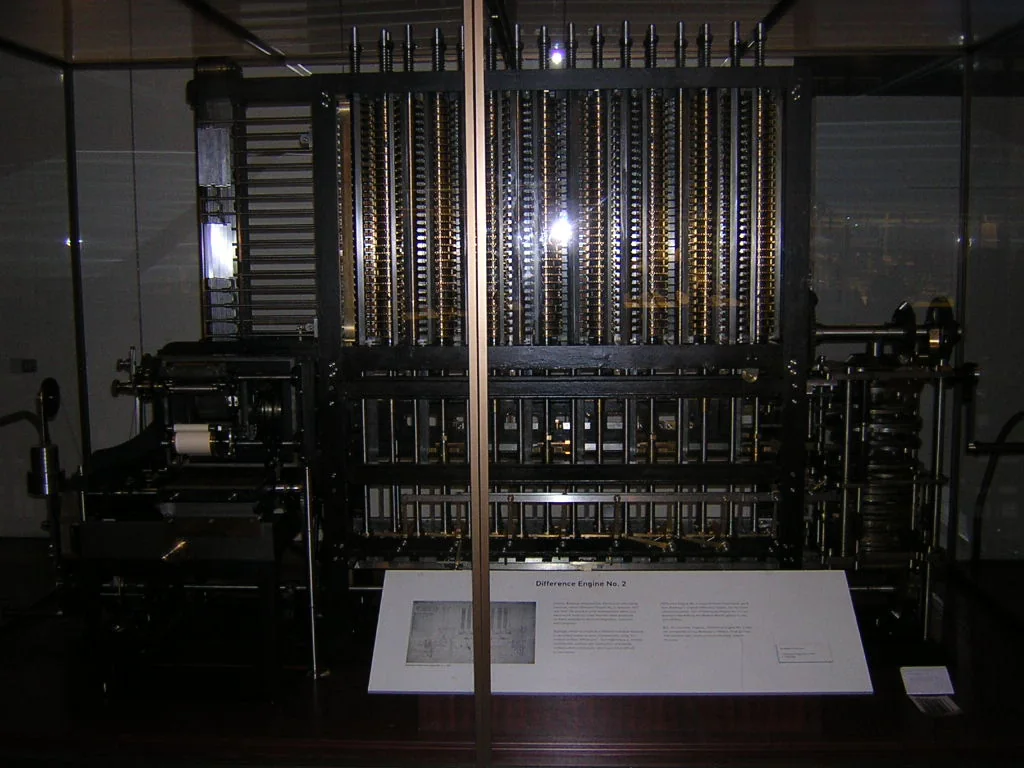
Difference Engine No. 2: an improved design
Babbage did not completely abandon the idea of the Difference Engine.
Between 1847 and 1849, he designed a second version, now known as
Difference Engine No. 2.
This new machine benefited from the experience he had gained while
working on the Analytical Engine.
The design was more elegant and required far fewer parts than the first
version while still being capable of substantial calculations.
But it was not built during his lifetime.
The plans remained on paper for more than a century.
It was precisely this second version that would later make it possible
to answer an essential historical question:
Could Babbage’s plans actually work?
The Science Museum takes up the challenge
Beginning in the 1980s, the Science Museum in London undertook a
detailed study of the plans for Difference Engine No. 2.
Under the direction of Doron Swade, a team decided to build the machine
while following Babbage’s drawings as closely as possible.
The project had considerable historical importance.
If the machine worked, it would show that Babbage’s principles were
mechanically viable.
If it failed because of fundamental errors in the plans, the historical
assessment would be very different.
In 1991, to mark the bicentenary of Babbage’s birth, the Science Museum
completed the calculating section of Difference Engine No. 2.
The machine worked.
It successfully calculated values using the method of differences.
What about the printer?
Babbage had also designed an output mechanism capable of automatically
printing the results.
The Science Museum therefore continued the project.
In 2000, the machine’s printer was completed.
It could not only print results on paper but also produce plates
intended for printing.
This detail confirms the scope of Babbage’s original ambition.
He was not merely trying to speed up a calculation.
He wanted to eliminate human errors throughout the entire chain, from
calculation to reproduction of the result.
Does the reconstruction prove the machine could have been built in the 19th century?
The modern reconstruction is often presented as proof that Babbage was
“right.”
That is broadly true at the conceptual level, but a qualification is
necessary.
The Science Museum built the machine using modern manufacturing
resources, although the goal was to respect tolerances that Victorian
industry could have achieved.
Its success primarily demonstrates that Babbage’s mechanical design
was coherent and functional.
It does not prove that constructing a complete machine would have been
easy, economical, or practical under the exact conditions of the
original project.
Manufacturing thousands of precise parts, assembling them, and
maintaining them represented a formidable industrial challenge.
The brilliance of the design and the practical difficulties of the
project can therefore both be true at the same time.
A decimal machine, not a binary one
Modern computers generally represent information using bits and operate
with the binary system.
Babbage’s machine worked differently.
It was decimal.
Its wheels directly represented the digits from 0 to 9.
This is a useful reminder that binary is not a mandatory condition for
building a calculating machine.
The choice of representation depends on the technology being used.
For a mechanical device made of toothed wheels, representing ten decimal
positions could be natural.
Electronic computers would later adopt binary overwhelmingly because two
distinct physical states are particularly convenient to represent with
electronic circuits.
Was the Difference Engine a computer?
The answer depends on what we mean by a computer.
The Difference Engine could:
represent numbers;
automatically perform operations;
retain intermediate values;
chain calculations together;
produce results.
But it was not a programmable general-purpose machine like a modern
computer.
Its mechanism was designed to apply a particular method.
It is therefore more accurate to describe it as a specialized
automatic calculating machine.
Babbage’s later Analytical Engine would take a further conceptual step
by introducing the idea of a machine capable of following different
programs.
From numerical tables to automated pipelines
The Difference Engine illustrates an idea that remains surprisingly
modern: when a repetitive process contains several stages where errors
can occur, we can try to automate the entire chain.
Babbage’s problem was not limited to calculation.
It involved:
producing the values;
transcribing them;
formatting them;
printing them.
Every additional human intervention created another opportunity for
error.
His goal was therefore to move the result from one stage to the next
without manual re-entry.
The same logic can be found today in scripts, data-processing chains,
and software pipelines: automating not only a single operation, but
the complete passage of data through several transformations.
The technologies have changed. The fundamental problem remains familiar.
Why is the Difference Engine important?
The Difference Engine did not immediately revolutionize industry.
Its first version was not even completed.
Its importance is primarily historical and conceptual.
It shows that, at the beginning of the 19th century, it was already
possible to imagine:
a complex calculation broken down into elementary operations;
automatic execution of those operations;
mechanical memory for retaining values;
automatic carry propagation;
mechanical production of results;
a chain designed to reduce human error.
It also represents a decisive stage in Charles Babbage’s intellectual
development.
By trying to automate the production of tables, he eventually began
asking whether a machine could be designed not for one calculation,
but for many different calculations.
That question led directly to the Analytical Engine project.
Key takeaways
Charles Babbage’s Difference Engine arose from a very practical problem:
19th-century mathematical tables were indispensable, but calculating and
printing them manually introduced errors.
Babbage proposed mechanizing the process.
His idea rested on several essential principles:
use the method of finite differences to replace complex
calculations with additions;
represent numbers using mechanical wheels;
automate the sequence of operations;
retain intermediate values;
automate the output as well, in order to avoid transcription errors.
The first large machine was never completed.
But the later plans for Difference Engine No. 2 allowed the Science
Museum to build a working machine more than a century after Babbage’s
death.
Its success shows that his project was not simply an impossible fantasy.
More importantly, the difficulties and possibilities discovered during
this undertaking pushed Babbage toward an even more ambitious idea: the
Analytical Engine, one of the major conceptual ancestors of the
programmable computer.
Frequently asked questions
What was the Difference Engine designed to do?
It was designed to automatically calculate mathematical tables,
particularly values of functions that could be obtained using the method
of finite differences, and to help produce those results without the
errors associated with manual calculation and transcription.
Why did it use the method of finite differences?
The method makes it possible to calculate the values of certain
polynomials using essentially addition. Because addition is mechanically
simpler to implement than multiplication or division, it was
particularly well suited to the machine.
Did Charles Babbage complete his Difference Engine?
No. Difference Engine No. 1 was never completed. Babbage later designed
an improved second version, Difference Engine No. 2, which also remained
on paper during his lifetime.
Was a Babbage Difference Engine eventually built?
Yes. The Science Museum in London built Difference Engine No. 2 from
Babbage’s plans. The calculating section was completed in 1991 and its
printing mechanism in 2000. The machine works.
Was the Difference Engine programmable?
Not in the sense of a modern general-purpose computer. It was designed
to automate a particular kind of calculation. Babbage’s next project,
the Analytical Engine, introduced a far more general and programmable
design.
What is the connection between the Difference Engine and Ada Lovelace?
Ada Lovelace is primarily associated with the Analytical Engine, the
more ambitious project Babbage developed after his work on the
Difference Engine. Her notes on that machine notably include a method
for calculating Bernoulli numbers.
Explore Ada Lovelace's life, her collaboration with [Charles Babbage](/en/resources/charles-babbage-father-computing), her Bernoulli numbers algorithm, and the legacy of the woman often described as the first computer programmer.