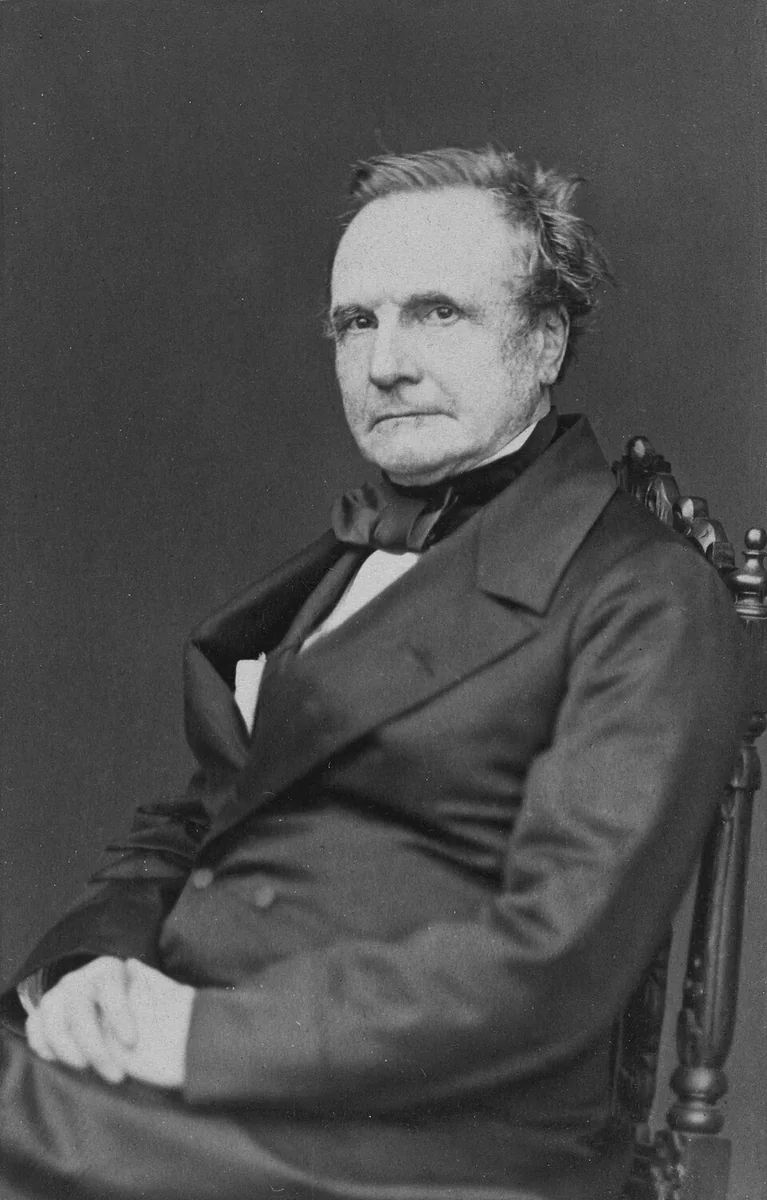
Charles Babbage holds a central place in the prehistory of computing.
Born in 1791, this British mathematician, inventor, and reformer devoted
much of his life to an extraordinary idea: building machines that could
perform complex calculations automatically and then sequence operations
according to instructions.
His projects were never completed in the form he envisioned. Yet the
Difference Engine, and especially
the Analytical Engine, already
contained several principles found in modern computers.
Mathematical tables full of errors
In the early nineteenth century, navigation, astronomy, engineering, and
insurance depended on numerical tables calculated and copied by hand. A
calculation or typesetting error could have serious consequences.
Babbage’s frustration led to a simple question: if repetitive
calculations follow rules, why not entrust them to a machine? He sought
to mechanize not only calculation but also the printing of results,
removing transcription errors from the chain.
The Difference Engine
Beginning in the 1820s, Babbage designed a mechanical machine based on
finite differences. This method generates polynomial function values
largely through successive additions.
The British government funded part of the project. Engineer Joseph
Clement produced remarkably precise components and a working section was
built, but costs, manufacturing difficulties, design changes, and
tensions between Babbage and Clement prevented completion of the full
machine.
That industrial failure did not prove the concept impossible. In 1991,
London’s Science Museum completed Difference Engine No. 2 from Babbage’s
plans using techniques compatible with his era. It worked and produced
the expected results.
From calculator to programmable machine
Babbage soon understood that a specialized machine remained limited. He
therefore imagined a much more general architecture: the Analytical
Engine.
This new machine would contain a store for retaining numbers and a
mill for carrying out operations. Data and instructions would be
entered with punched cards inspired by the Jacquard loom.
Babbage also planned repetition and changes in the order of operations.
The machine would no longer be only a calculator: it could follow
different programs.
Babbage met Ada Lovelace in 1833. She immediately took an interest in
his work, beginning a lasting intellectual relationship.
In 1843, Lovelace published her translation of Luigi Menabrea’s account
of the Analytical Engine with seven extensive notes. Note G presents a
method for calculating Bernoulli numbers. Her work made Babbage’s
architecture more accessible and explored uses beyond numerical
calculation.
Their collaboration should be understood as an exchange. Babbage
mastered the machine’s design and had already prepared sequences of
operations; Lovelace contributed a published presentation, an
algorithmic organization, and a remarkable vision of symbolic
processing.
An inventor with many interests
Reducing Babbage to calculating machines would obscure the range of his
interests. Throughout his career he studied mathematics, economics,
statistics, cryptography, railways, industrial standards, and public
safety.
In 1832, he published On the Economy of Machinery and Manufactures, an
analysis of industrial organization. He examined the division of labor,
productivity gains, and the effects of mechanization on production.
These ideas influenced nineteenth-century economists and engineers.
Babbage also took part in statistical inquiries. He cared about the
quality of scientific data, methods of measurement, and the ways
numerical evidence could inform public decisions. He proposed devices
for railway safety, postal improvements, and fraud prevention.
His perfectionism, however, hindered his ambitions. Convinced that every
design could be improved, he repeatedly revised plans before earlier
versions were finished. This constant pursuit of refinement contributed
to the delays and budget overruns that marked his career.
Why were his machines never completed?
There was no single cause. The mechanisms demanded great precision,
public funding became controversial, project management was difficult,
and Babbage continually pursued more ambitious designs.
The Analytical Engine in particular evolved over decades. It remained a
collection of plans, notations, and experimental parts rather than a
complete device.
Why Charles Babbage still matters
When Babbage died in 1871, none of his major machines had been
completed. For decades, his work remained little known outside British
scientific circles.
With the emergence of electronic computers in the mid-twentieth century,
historians revisited his plans and recognized how far several of his
ideas had anticipated later machines. The Analytical Engine included
memory for data, a unit for calculation, punched-card input, printed
output, and an organization for executing a sequence of instructions
automatically.
These concepts do not map exactly onto modern computers, but they are a
remarkable anticipation. That is why Babbage is regarded as one of the
fathers of computing even though his machines were entirely mechanical.
The Science Museum’s 1991 construction of Difference Engine No. 2, using
manufacturing techniques compatible with the nineteenth century,
demonstrated that the design worked. Babbage’s difficulties stemmed
primarily from the industrial, financial, and organizational limits of
his time rather than a fundamentally mistaken concept.
His influence now extends beyond computing history. Breaking a complex
problem into a succession of elementary operations remains a foundation
of programming. Modern processors and algorithms execute electronically
an idea Babbage had imagined with gears almost two centuries ago.
Timeline
- 1791: Charles Babbage is born in London.
- 1810: he enters Trinity College, Cambridge.
- 1822: he presents an early Difference Engine model.
- 1823: the British government provides financial support.
- 1833: he meets Ada Lovelace.
- 1834–1837: the principles of the Analytical Engine take shape.
- 1843: Menabrea’s paper, translated and annotated by Lovelace, is
published.
- 1847–1849: Babbage designs Difference Engine No. 2.
- 1871: Charles Babbage dies.
- 1991: the Science Museum completes a working Difference Engine
No. 2.
Frequently asked questions
Did Charles Babbage invent the first computer?
Not in the modern sense. He did, however, imagine the first
general-purpose programmable machine with an architecture resembling
several aspects of today’s computers. It was never fully built in his
lifetime.
Why is Charles Babbage considered a computing pioneer?
He was the first to design a machine capable of automatically sequencing
instructions, storing data, and performing different kinds of
calculations rather than one fixed task.
What role did Ada Lovelace play in his work?
Lovelace recognized the Analytical Engine’s potential early. Her 1843
notes explained its operation and presented one of the first published
algorithms intended for a programmable machine.
Why were Babbage’s machines never finished?
Several factors combined: the limits of nineteenth-century mechanical
industry, very high costs, project-management difficulties, and
Babbage’s perfectionism, which led him to revise designs before
completing them.
Are Charles Babbage’s ideas still used today?
Yes. Modern computers are electronic rather than mechanical, but their
broad organization—memory, a processing unit, and sequential
instruction execution—echoes principles Babbage had already imagined.