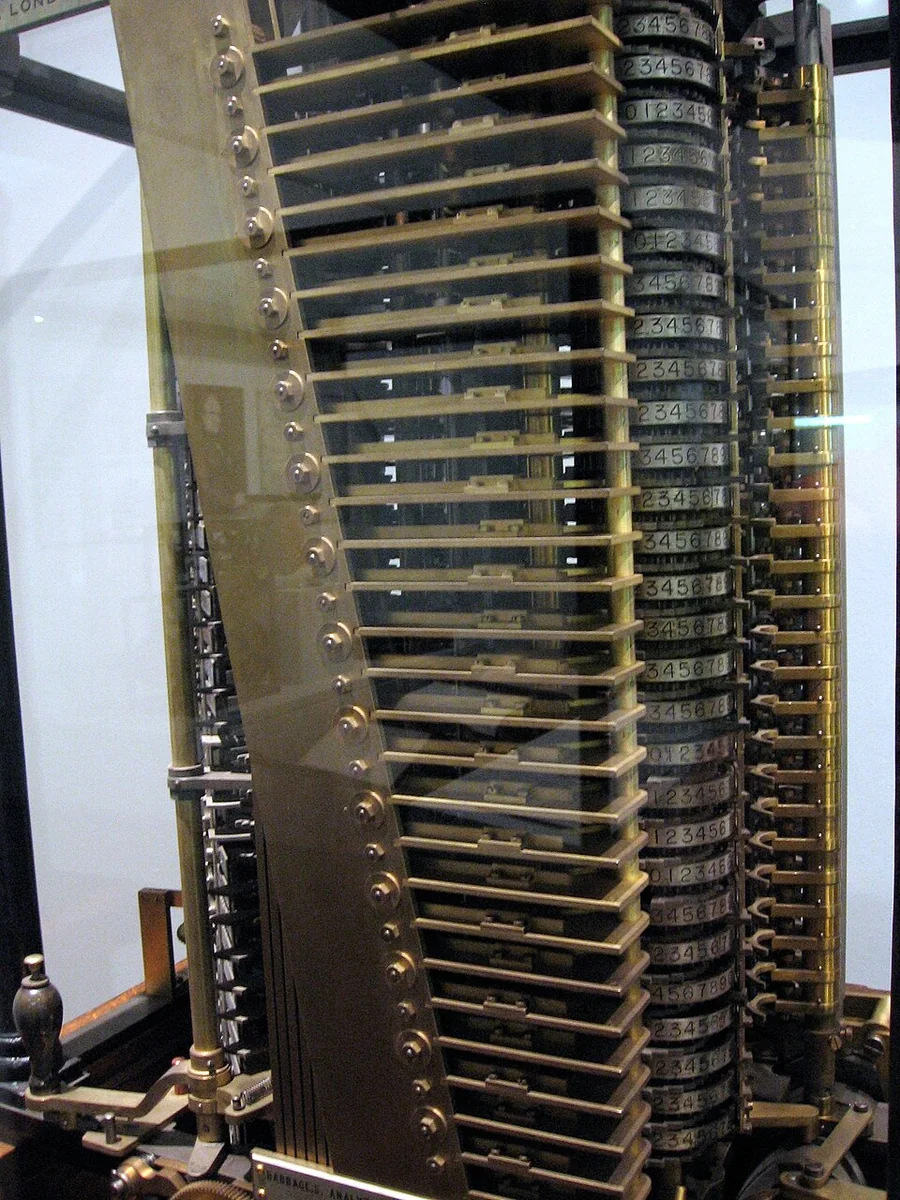
The Analytical Engine imagined by Charles Babbage in the nineteenth century occupies a unique place in the history of computing. It was never completed during its designer’s lifetime and obviously bore little physical resemblance to the electronic computers that would appear more than a century later. Yet its architecture already brought together several ideas that we now associate with a general-purpose programmable machine: memory, a calculation unit, instructions, data, and a mechanism for controlling the order of operations.
That is precisely what makes the Analytical Engine so fascinating.
Babbage was no longer trying merely to build a calculator capable of carrying out one predetermined operation. He imagined a machine whose behavior could be changed by a program.
That distinction marks an essential step in the history of automatic computation.
To understand how such an idea could emerge in the England of the 1830s, however, we must begin with the machine that preceded it: the Difference Engine.
Before the Analytical Engine: automating numerical tables
At the beginning of the nineteenth century, scientists, engineers, navigators, and astronomers relied on numerous numerical tables.
These tables made it possible to obtain values of mathematical functions quickly without recalculating everything by hand.
The problem was that producing them depended heavily on human computation.
Errors could occur during calculation, copying, or printing.
For Babbage, a British mathematician particularly sensitive to these imperfections, one solution stood out: mechanize calculation.
He therefore designed a first machine intended to produce certain mathematical tables automatically.
This was the Difference Engine.
The Difference Engine was not yet a general-purpose computer
The Difference Engine exploited the mathematical method of finite differences.
This method makes it possible to evaluate certain polynomials mainly through successive additions, which is particularly well suited to mechanical implementation.
The project was extraordinarily ambitious for its time.
Thousands of parts had to work together with considerable precision.
Babbage obtained support from the British government and began construction of the machine in the 1820s.
But technical, financial, and organizational difficulties accumulated.
The complete project was never finished.
Babbage did not, however, abandon the idea of mechanical computation.
Instead, he went much further.
Rather than merely improving a machine specialized in producing tables, he began imagining a machine capable of performing many different kinds of calculation.
The Analytical Engine emerged from this change in perspective.
From a specialized calculator to a programmable machine
The fundamental difference between the two projects lies in their ambition.
The Difference Engine was designed for a particular family of calculations.
The Analytical Engine was intended to execute different sequences of operations according to the instructions supplied to it.
In other words, Babbage progressively separated two things:
the physical machine;
the program that determines what it does.
Today, this separation seems obvious.
A computer can be used to write a document, run a game, edit an image, or analyze data simply by changing software.
In the nineteenth century, the idea was profoundly innovative.
The Analytical Engine was no longer merely a calculating machine.
It became the project for a general-purpose programmable machine for processing numerical and symbolic representations.
A surprisingly modern architecture
To describe his machine, Babbage notably used two terms borrowed from the industrial world:
the Store;
the Mill.
The Store was where numbers were to be kept.
The Mill was where operations were to be performed.
The comparison with a modern computer is tempting.
The Store evokes memory.
The Mill evokes a calculation unit, and, by very cautious analogy, part of the role played today by a processor.
This conceptual resemblance is real, but it should not be pushed too far.
Babbage’s machine was mechanical.
It relied on toothed wheels, gears, shafts, and transmission mechanisms.
It obviously had no transistors, electronic memory, or microprocessor.
What is remarkable, therefore, is not a material resemblance to our computers.
It is the logical organization of the system.
The Store: keeping values in memory
The Store was intended to retain the numbers used during calculations.
A general-purpose programmable machine must be able to keep intermediate values, reuse them, and modify them.
Without memory, organizing a complex sequence of operations becomes extremely difficult.
Babbage therefore planned a mechanical area dedicated to storage.
Values were represented by the positions of decimal wheels.
Each wheel could represent a digit.
Several wheels assembled together could represent numbers containing many digits.
This memory was very different from the bits used by modern computers, but its conceptual function is familiar: retain data so that the machine can use it later.
The Mill: performing operations
The Mill was the part of the machine responsible for calculations.
Numbers from the Store had to be transferable to it, transformed by an operation, and then possibly returned to memory.
The machine was intended to perform the four fundamental arithmetic operations:
addition;
subtraction;
multiplication;
division.
This separation between storage and processing is one of the aspects most often compared with the organization of later computers.
But again, anachronism should be avoided.
The Mill was not a modern processor hidden inside Victorian mechanics.
It was a mechanical solution designed with nineteenth-century technologies and constraints.
The comparison is useful for understanding functions, not for claiming that the architectures were identical.
How do you program a mechanical machine?
A general-purpose machine becomes truly interesting only if it can be told which operations to perform.
Babbage drew inspiration from a technology already used in another industry: punched cards.
The loom developed by Joseph-Marie Jacquard used punched cards to control the patterns woven by the machine.
Depending on the presence or absence of holes, the mechanism performed different actions.
The idea was powerful: a sequence of instructions could be represented on a physical medium external to the machine.
Babbage adopted this principle for the Analytical Engine.
Our article on punched cards traces their broader role, from Jacquard looms to early computing systems.
Several types of cards
In Babbage’s plans, the cards did not all have exactly the same function.
Some were intended to specify the operations to perform.
Others were used to select or manipulate the variables involved.
This organization made it possible to distinguish instructions from the values on which they operated.
A sequence of cards could therefore describe a complex procedure.
The machine would read the instructions and mechanically execute the corresponding operations.
The program thus existed in a physical form independent of the machine’s internal mechanism.
That was a considerable conceptual step.
The program becomes something that can be changed
With a specialized mechanical calculator, the function of the machine is largely determined by its construction.
With the Analytical Engine, changing the processing does not necessarily require rebuilding the entire machine.
In principle, supplying another sequence of cards is enough.
The same mechanism can therefore execute different programs.
This idea anticipates one of the fundamental principles of computing:
a general-purpose machine can perform different tasks when its instructions change.
A century later, this idea would take much more advanced forms through computability theory, universal machines, and stored-program computers.
Could the machine execute loops?
Yes, and this is a particularly important point.
Babbage envisaged mechanisms allowing certain sequences of instructions to be repeated.
In a modern program, we might use a loop:
repeat 10 times:
    perform an operation
The Analytical Engine was intended to achieve comparable behavior through control of card reading.
Repetition is essential.
Without it, a program requiring one hundred executions of the same operation would need to describe that operation explicitly one hundred times.
A loop represents the process much more efficiently.
What about conditional branching?
The plans and descriptions of the Analytical Engine also included control mechanisms depending on results obtained during calculation.
The general idea is that a result can influence what happens next.
In a modern language, this is conceptually similar to:
if condition: do Aelse: do B
The terminology and mechanisms were obviously different, but the ability to alter the flow of a calculation according to its state is fundamental.
With memory, arithmetic operations, repetition, and conditional control, the machine went far beyond a simple calculator.
Ada Lovelace enters the story
The Analytical Engine is inseparable from Ada Lovelace.
The daughter of the poet Lord Byron and Anne Isabella Milbanke, Ada developed an early interest in mathematics and science.
She met Charles Babbage in the 1830s and became deeply interested in his machines.
In 1842, Italian engineer Luigi Federico Menabrea published a French article describing the Analytical Engine based on a lecture given by Babbage.
Ada Lovelace translated the text into English.
But she did far more than translate it.
She added a series of notes of her own that were much longer than the original article.
These notes became some of the most famous documents in the history of computing.
The biography of Ada Lovelace explores her life, her collaboration with Babbage, and the significance of her ideas in greater detail.
The Bernoulli numbers program
Among Lovelace’s notes is a detailed method intended to enable the Analytical Engine to calculate Bernoulli numbers.
This procedure is often described as the first published computer program intended for a general-purpose machine.
That description nevertheless requires some caution.
Ada Lovelace obviously never executed the program on a complete Analytical Engine, since no such machine was ever built.
Babbage had also already devised various example procedures for his machine.
The historical importance of Lovelace’s note lies especially in the explicit and published way in which it describes a sequence of operations intended to be carried out automatically by the machine.
Rather than trying to identify one absolute “first programmer,” it is more useful to understand what these works reveal: by the middle of the nineteenth century, Babbage and Lovelace were already reasoning about programs for a general-purpose machine that did not yet physically exist.
Lovelace understands that the machine can manipulate more than numbers
One of Lovelace’s most remarkable insights concerns the nature of data.
The Analytical Engine mechanically works with numbers.
But Lovelace understood that those numbers could represent more than simple quantities.
If musical relationships, for example, could be expressed in an appropriate form, a machine could in principle manipulate those representations according to rules.
This insight goes beyond arithmetic.
Modern computers rely precisely on this general principle: the same electronic devices can manipulate numbers, text, images, sound, or programs because all of this information can be represented in encoded form.
Lovelace was obviously not describing modern multimedia computing.
But she already perceived an essential distinction between the physical form of the symbols being manipulated and what those symbols can represent.
A machine capable of creating?
Lovelace is also famous for an observation frequently discussed in relation to the capabilities of machines.
She essentially emphasized that the Analytical Engine did not claim to originate anything by itself: it carried out what humans knew how to order it to perform.
More than a century later, Alan Turing explicitly returned to this objection when discussing machine intelligence.
This intellectual dialogue across time is fascinating.
Lovelace considered the limits of a programmed machine.
Turing would later ask whether a machine could produce behavior that its designers had not anticipated in every detail.
Its construction required a very large number of precision mechanical parts.
Nineteenth-century manufacturing techniques could produce remarkable components, but building and assembling such a complex system represented a considerable challenge.
Costs were also high.
Babbage had already received substantial public funding for the Difference Engine.
Relations with the British government deteriorated as the project progressed.
Disagreements also arose with his engineer and manufacturer Joseph Clement, whose expertise was essential to the construction of the early parts.
Added to this was a characteristic of Babbage himself: he continually improved his designs.
Rather than quickly freezing one model in order to complete it, he explored new solutions and developed increasingly ambitious versions.
The Analytical Engine therefore remained primarily a collection of plans, drawings, descriptions, and partial components.
Was it technically impossible to build?
No.
That is an important nuance.
The fact that Babbage did not complete his machines does not necessarily mean that their mechanical principles were impossible to realize.
Using historical plans, the Science Museum in London notably constructed a complete version of the Difference Engine No. 2, designed later by Babbage.
The machine works.
This achievement demonstrates that the mechanical principles of that Difference Engine were sound.
For the Analytical Engine, the situation is more complicated: its plans evolved over many years and do not always correspond to a single final model ready for assembly.
Researchers and historians therefore continue to study the possibility of reconstructing certain versions from Babbage’s archives.
What would the machine have looked like?
Forget the image of a small computer sitting on a desk.
The Analytical Engine would have been enormous.
It would have consisted of thousands of mechanical components.
Shafts, wheels, and gears would have transmitted values and operations.
Power was to be supplied mechanically, notably by an external source of motive power.
Its operation would have produced a spectacle very different from the relative silence of a modern electronic chip.
It should be imagined as a genuine precision industrial installation.
This physical scale helps us appreciate the audacity of the project.
Babbage was trying to embody concepts of general-purpose programming using technologies derived from the mechanics of his era.
How would results have been produced?
Babbage did not think only about internal calculation.
A useful machine must also make its results available.
Several output mechanisms were envisaged.
Results could notably be printed.
Babbage even considered mechanisms for preparing plates for printing in order to reduce human errors when results were transcribed.
This concern came directly from the problem that had motivated his first machines: producing reliable numerical tables without reintroducing mistakes when copying them.
A complete chain was already present:
input → processing → memory → output.
Did the Analytical Engine use binary?
No.
This is an important difference from most modern computers.
Babbage’s machine was designed around a decimal representation.
Mechanical wheels represented the digits from 0 to 9.
Our electronic computers generally use binary because electronic components lend themselves particularly well to representing two states.
But binary is not a requirement for a general-purpose programmable machine.
The Analytical Engine reminds us that we must distinguish between:
the logic of computation;
the physical way in which data is represented.
Was it Turing-complete?
This question is often asked, but it must be treated carefully.
The notion of Turing completeness obviously appeared long after Babbage.
It refers to the theoretical ability of a system to perform any computation that can be carried out by a Turing machine, under certain assumptions about resources.
The Analytical Engine had several characteristics required for general computation: memory, operations, repetition, and control over execution flow.
Modern analyses have argued that certain versions of the machine can be interpreted as capable of general computation.
But directly applying twentieth-century terminology to a nineteenth-century machine can obscure historical and technical differences.
It is safer to say that Babbage designed a general-purpose programmable machine whose organization displayed several properties that computability theory would formalize much later.
To understand that formalization, our article on the Turing machine explains what computability means and why Turing completeness is a theoretical concept.
Did Babbage invent the computer?
It depends on what we mean by “computer.”
If we require a built and operational electronic machine, obviously not.
If we are looking for the origins of some fundamental concepts of a general-purpose programmable machine, however, the Analytical Engine is a major milestone.
It brought together, among other things:
a storage unit;
a calculation unit;
external instructions;
data;
repetition mechanisms;
control mechanisms;
input and output devices.
This combination explains why Babbage is often regarded as one of the major precursors of the computer.
But the history of computing cannot be reduced to the sudden invention of a machine by a single person.
The modern computer resulted from many stages: mathematics, logic, punched-card data processing, electromechanics, electronics, information theory, machine architecture, and the development of programming languages.
The Analytical Engine is an extraordinarily early stage in this history, not its culmination.
Analytical Engine and Turing machine: a fundamental difference
It is tempting to place Babbage and Turing on a perfectly continuous line.
Reality is subtler.
Babbage sought to design a physical programmable machine.
He thought about gears, mechanical transfers, number storage, card reading, and printing results.
In 1936, Turing constructed an abstract mathematical model in order to define what a computable procedure is.
The Turing machine is not the mechanical successor of the Analytical Engine.
The two projects answer different questions.
But comparing them reveals a fundamental evolution.
Babbage asks:
How can we build a general-purpose machine capable of executing different calculations?
Turing asks:
What exactly does it mean to be capable of carrying out a computation?
A century separates the two questions.
Together, they illuminate two essential dimensions of computing: the machine and the theory of computation.
Stored-program computers developed in the middle of the twentieth century can keep their instructions in electronic memory accessible to the machine.
In the Analytical Engine, the program was mainly to be supplied through external cards.
This difference is major.
For Babbage, the memory for values and the medium containing instructions remained conceptually and physically distinct.
In a stored-program architecture, instructions and data can both be represented in the machine’s memory.
It would therefore be wrong to present the Analytical Engine as a von Neumann computer built a hundred years too early.
It anticipated some functions of a general-purpose computer, but its organization was different.
This distinction makes its history even more interesting: the fundamental concepts of computing did not all appear at once.
They emerged progressively.
Why was Babbage forgotten for a time?
In the nineteenth century, the Analytical Engine remained unfinished.
It therefore did not immediately trigger an industrial revolution in computation.
Office calculating machines, tabulators, and punched-card systems that developed later followed other technical paths.
Babbage’s work remained known in some circles, but its significance in the history of computing became more widely recognized once programmable computers became a reality.
With hindsight, historians could then see just how ambitious some of the ideas formulated a century earlier had been.
This retrospective recognition must nevertheless avoid one trap: rewriting the nineteenth century using the exact vocabulary of modern computing.
Babbage and Lovelace should be understood in their own context.
That is precisely what makes their work remarkable.
An idea more important than the machine itself
The Analytical Engine never executed the programs imagined for it.
It never calculated the Bernoulli numbers described in Lovelace’s notes.
It never operated as a complete installation.
And yet it occupies a major place in the history of computing.
Why?
Because an object can have historical importance even when it is never completed.
Babbage’s plans show that he understood several essential properties of a general-purpose programmable machine.
Lovelace’s notes show that people could already reason about programs, data, and the possibilities of such a machine before it physically existed.
The innovation therefore lies as much in the concepts as in the gears.
From mechanics to software
The Analytical Engine reveals a profound intellectual transformation.
Initially, a machine is generally designed to perform a particular function.
A loom weaves.
A clock measures time.
A calculator performs certain calculations.
With a general-purpose programmable machine, part of the function moves out of the mechanism and is defined by the instructions.
The same physical device can change its behavior without being completely rebuilt.
This idea would become fundamental in the twentieth century.
It gradually leads to a distinction that still structures all modern computing:
hardware provides capabilities; software largely determines what the machine does with them.
Babbage obviously did not use these words in their present meaning.
But the Analytical Engine is directly part of the history of this separation.
What the Analytical Engine was not
Its historical importance sometimes leads people to retrospectively attribute almost every characteristic of a modern computer to it.
That temptation should be resisted.
The Analytical Engine:
was not electronic;
did not use transistors;
was not binary;
had no electronic memory;
did not store its program in memory like a modern computer;
was never completed as a fully operational machine;
did not by itself constitute all of modern computing.
These differences do not diminish its importance.
On the contrary, they allow us to appreciate the originality of the project in its actual context.
Babbage imagined a general-purpose programmable machine using the conceptual and mechanical tools available in the nineteenth century.
That alone was extraordinary.
A legacy connecting several centuries
The history of the Analytical Engine reveals a remarkable thread.
At the beginning of the nineteenth century, punched cards controlled weaving looms.
Babbage imagined using them to program a general-purpose calculating machine.
Ada Lovelace described procedures intended for that machine and reflected on the possibility of symbolically manipulating more than simple quantities.
A century later, Alan Turing mathematically formalized general computation.
Early electronic computers then made it possible to execute complex programs rapidly.
Stored-program architectures allowed instructions themselves to be retained and manipulated in memory.
Finally, programming languages gradually made these machines accessible without requiring programmers to reason directly about their physical operation.
None of these stages alone explains the modern computer.
But the Analytical Engine is one of the earliest places where several essential ideas appeared together in a single project.
Why the Analytical Engine still matters today
First, it shows that the history of computing began long before electronics.
The fundamental problems already existed:
how should data be represented?
how can values be stored?
how can a sequence of operations be described?
how can instructions be repeated?
how can the flow of a calculation be changed?
how can a result be produced automatically?
These questions are still present in modern computers, even though the technical solutions have changed radically.
The Analytical Engine also reminds us that an important innovation can appear long before technology makes it easy to implement.
Babbage had the idea of a general-purpose programmable machine.
What he lacked was an industrial, economic, and technological environment capable of turning that idea into a practical computer.
Key takeaways
Charles Babbage’s Analytical Engine is one of the most ambitious projects in the history of mechanical computation.
Designed from the 1830s onward, it went beyond the specialized Difference Engine by proposing a general-purpose programmable machine.
Its architecture notably included:
a Store for retaining values;
a Mill for performing operations;
punched cards for supplying instructions and data;
mechanisms allowing repetition;
possibilities for controlling execution flow;
input and output devices.
Ada Lovelace played an essential role in understanding and communicating the project. Her notes show that she saw the machine not simply as a calculator, but as a system capable of manipulating representations according to rules.
The Analytical Engine was never completed.
It was neither an electronic computer, nor a stored-program computer, nor a von Neumann architecture ahead of its time.
But it introduced very early an idea that would become fundamental:
the same machine can perform different tasks according to the program supplied to it.
It is this idea, even more than its gears, that permanently places the Analytical Engine in the history of computing.
Frequently asked questions
Who invented the Analytical Engine?
The Analytical Engine was designed by British mathematician Charles Babbage beginning in the 1830s.
What is the difference between the Difference Engine and the Analytical Engine?
The Difference Engine was designed mainly to automate the calculation of certain numerical tables. The Analytical Engine was far more ambitious: it was intended to execute different programs and perform general calculations.
Did the Analytical Engine ever actually work?
No. Babbage never completed a fully operational Analytical Engine. The project is known mainly through his plans, drawings, descriptions, and partial components.
What were the Store and the Mill for?
The Store was intended to retain numbers and intermediate results. The Mill was intended to perform arithmetic operations. Their functions can cautiously be compared with memory and the calculation unit of a modern computer.
How was the Analytical Engine programmed?
Babbage planned to use punched cards, inspired in particular by Jacquard looms, to provide the instructions and information required to carry out calculations.
Was Ada Lovelace the first programmer?
She is often described that way because of her published description of a procedure intended to calculate Bernoulli numbers on the Analytical Engine. The historical reality is more nuanced, particularly because Babbage himself had devised procedures. Her role nevertheless remains major in the history of programming and in interpreting the possibilities of a general-purpose machine.
Was the Analytical Engine a modern computer?
No. It was mechanical and decimal, and its program was to be supplied by cards. It nevertheless possessed several functions conceptually found in computers: memory, a calculation unit, a program, control, and input-output.
Was the Analytical Engine Turing-complete?
The question uses a concept developed a century later. Some modern analyses consider Babbage’s designs to have contained the mechanisms required for general computation. Historically, it is more cautious to describe it as a general-purpose programmable machine rather than applying later terminology without qualification.
Explore Ada Lovelace's life, her collaboration with [Charles Babbage](/en/resources/charles-babbage-father-computing), her Bernoulli numbers algorithm, and the legacy of the woman often described as the first computer programmer.