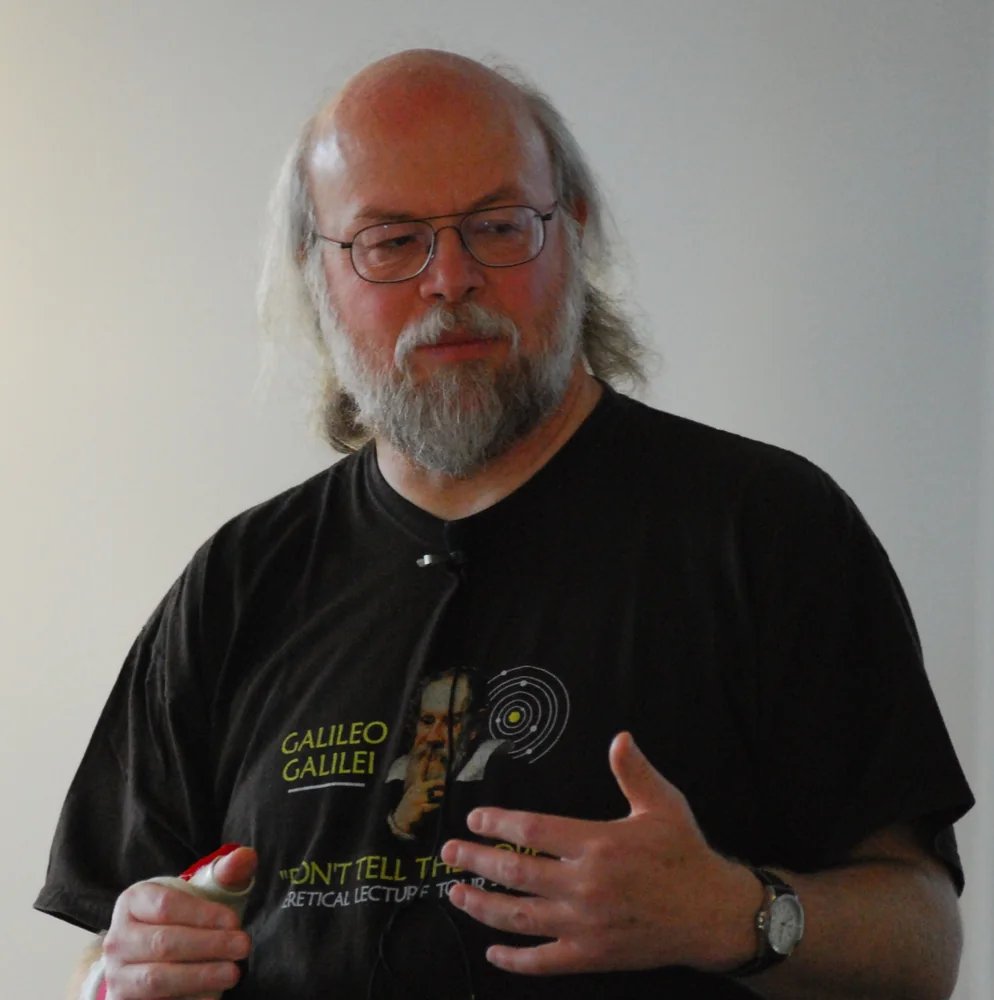
James Gosling is often called the “father of
Java.” The phrase is convenient, but it
hides the question that makes his work interesting: how can the same
software run on very different machines while retaining the safety
required by connected devices?
In the early 1990s, Gosling pursued an answer with a small team at Sun
Microsystems. The result began neither as a Web language nor as a
solitary invention. Oak, the future Java, was initially part of the
Green project, a collective experiment in embedded computing. Its move
to the Web later gave it worldwide visibility.
Programming beyond the workstation
James Arthur Gosling was born near Calgary, Canada, in 1955. After
studying at the University of Calgary, he earned a doctorate from
Carnegie Mellon University in 1983. His thesis concerned algebraic
manipulation of constraints, but his work already showed an interest in
programming tools, including a text editor connected to the history of
Emacs.
He joined Sun Microsystems in 1984. Sun sold Unix workstations and
placed networks at the center of computing. By the end of the decade,
the company saw that software might also move into consumer devices:
interactive boxes, remote controls, terminals, and equipment with varied
processors.
That diversity created a problem. Code compiled directly for one
processor generally had to be adapted or recompiled for another. Common
languages also exposed memory operations that could create elusive
failures. In devices distributed at scale, such defects were expensive.
From the Green project to Oak
In 1991, Patrick Naughton, Mike Sheridan, and James Gosling launched
Green at Sun. Gosling initially considered
C++, but found it difficult to guarantee
the simplicity, portability, and robustness they wanted. He designed
Oak, named after a tree visible from his office.
Oak retained syntax familiar to C and C++ programmers while removing
sources of complexity. It used automatic memory management, omitted
general pointer arithmetic, and organized programs around classes. It
compiled not to one processor’s instructions but to an intermediate
format: bytecode.
A virtual machine adapted to each system executed that bytecode. The
compiler produced a common program while the virtual machine handled
platform details. Bytecode verification and a controlled runtime also
aimed to restrict what downloaded programs could do.
The team built the Star7 interactive-terminal prototype and a character
named Duke. The intended market did not materialize, leaving Oak with
promising architecture but no adoption environment.
The Web changed the language’s direction
In 1993 and 1994, the Web moved beyond laboratories. Browsers displayed
documents on widely different computers—exactly the heterogeneous
setting Oak addressed.
The team redirected its work toward the browser. Oak needed a new name
because the existing one was protected; Java was announced in 1995
alongside HotJava. Applets, small programs embedded in pages,
demonstrated that one bytecode program could be downloaded and executed
on several systems.
“Write once, run anywhere” summarized the ambition. It never meant
every platform behaved identically: libraries, graphical interfaces,
virtual-machine versions, and performance could differ. It described an
architectural contract that moved much adaptation work into the Java
platform.
Applets disappeared after browser plugins produced security,
performance, and interoperability problems. Reducing Java to applets
misses the main story. The language and virtual machine found lasting
roles in enterprise applications, servers, development tools, and
indirectly the Android ecosystem.
A language defined by trade-offs
Java separately invented neither object-oriented programming, garbage
collection, nor virtual machines. Its achievement came from combining
these ideas in one coherent and accessible system.
Static typing detects some errors before execution. Automatic memory
management removes manual deallocation without eliminating every leak or
excessive consumption. Exceptions structure error propagation. The
standard library supplied common abstractions for networks, files,
interfaces, and concurrency.
Those choices have costs. A virtual machine adds an execution layer;
garbage collection can cause pauses; long-term compatibility can slow
efforts to simplify the past. Just-in-time compilers, improved
collectors, and later language versions progressively reduced these
constraints.
Java’s first portability promise relied on interpreting bytecode, which
could be slower than native compilation. Virtual machines therefore
adopted just-in-time compilation (JIT): they observe a running
program, identify frequently used sections, and translate them into
optimized machine code.
This turns an apparent weakness into adaptability. A static compiler
knows the program before launch; a virtual machine also observes actual
paths, types, and workload. It can optimize and later reverse decisions
when assumptions stop holding.
Security evolved similarly. Early applets used a sandbox to restrict
access to files and the system. Repeated vulnerabilities showed that a
complex software boundary is never an absolute guarantee. Java retained
verification and isolation mechanisms, but the browser ceased to be its
primary home.
From 2006, Sun released much of Java as free software through
OpenJDK. This did not remove trademarks or every governance tension,
but it allowed several organizations to maintain compatible
distributions. Java moved from a product led mainly by Sun toward a
platform supported by multiple companies and communities.
Gosling’s role in a collective work
Gosling was Java’s principal language designer and one of its most
visible advocates. Its specification, libraries, virtual machine, and
ecosystem nevertheless reflect many engineers, writers, and communities.
Patrick Naughton, Mike Sheridan, Bill Joy, Guy Steele, and successive
Sun teams played distinct roles.
That precision does not diminish Gosling. His work established a
direction: favor readability, portability, and verification while
remaining familiar enough to C-family programmers for broad adoption.
After Oracle acquired Sun, Gosling left in 2010. He later worked briefly
at Google, then at Liquid Robotics and Amazon Web Services. Java
continued evolving without depending on one person.
Why James Gosling still matters
Gosling’s legacy is larger than the number of Java programs. It appears
in a familiar idea: distribute software in an intermediate form and
entrust portability, optimization, and part of security to a shared
runtime.
The JVM now hosts languages including Kotlin, Scala, and Clojure. Its
longevity shows that Java’s infrastructure outgrew the original language
and that syntax alone rarely determines success. Tools, specifications,
libraries, compatibility, and community shape a language’s lifespan.
Timeline
- 1955: James Gosling is born near Calgary, Canada.
- 1977: He graduates in computer science from the University of
Calgary.
- 1983: He earns a computer-science doctorate at Carnegie Mellon.
- 1984: He joins Sun Microsystems.
- 1991: Green begins with Patrick Naughton and Mike Sheridan;
Gosling designs Oak.
- 1992: The Star7 experimental terminal is demonstrated.
- 1994: Oak is redirected toward Web use.
- 1995: Java and HotJava are publicly announced.
- 1996: JDK 1.0 is released.
- 2002: Gosling and the Java team receive the ACM Software System
Award.
- 2006: Sun announces Java’s open-source release; OpenJDK becomes
its open reference implementation.
- 2010: Gosling leaves Oracle after its acquisition of Sun.
- Today: Java and the JVM remain major platforms for long-lived
software.
Frequently asked questions
Did James Gosling create Java alone?
No. He was its principal designer, but Java emerged from Green and many
later Sun teams. Outside contributors also shaped the specification and
ecosystem.
Why was Oak renamed Java?
Oak was already protected as a trademark, so the team chose another name
before the 1995 announcement. “Java” describes no particular technical
feature.
No. Java compiles to bytecode for a virtual machine; JavaScript was
created at Netscape for browser scripting. Its name benefited from
Java’s visibility.
What does “Write once, run anywhere” mean?
One compiled program should run on any compatible virtual machine. It is
a portability goal, not a guarantee that graphics, libraries, or
performance are identical.
Is Java still used without applets?
Yes. Applets vanished from browsers, but Java remains common in servers,
enterprise systems, tools, and infrastructure. The JVM also runs other
languages.
What is Gosling’s most durable contribution?
He combined language and runtime choices into a credible portability
contract. The JVM ecosystem’s longevity shows that this architecture
matters as much as Java syntax.