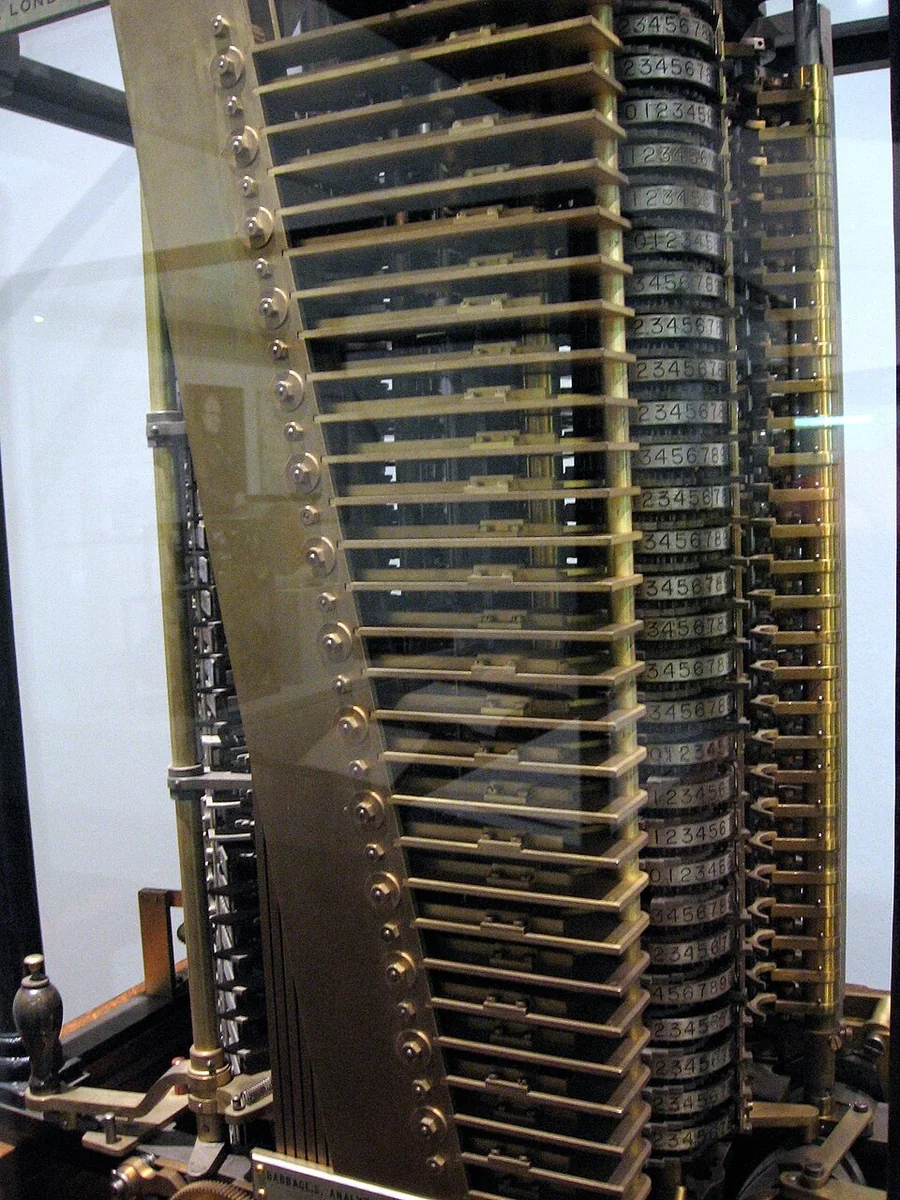
The Analytical Engine imagined by Charles Babbage in the nineteenth century occupies a unique place in computing history. It was never completed during its designer’s lifetime and bore little physical resemblance to the electronic computers that appeared more than a century later. Yet its architecture brought together several ideas associated with a general-purpose programmable machine: memory, a calculating unit, instructions, data, and control over the order of operations.
Babbage was no longer trying merely to build a specialized calculator. He imagined a machine whose behavior could be changed by a program. That distinction marks an essential step in the history of automatic computation.
Before the Analytical Engine: the Difference Engine
Early nineteenth-century scientists, engineers, navigators, and astronomers relied on numerical tables. Producing them involved human calculation, copying, and printing, all potential sources of error.
Babbage wanted to mechanize this work. His Difference Engine used finite differences to produce certain mathematical tables automatically. The project, begun in the 1820s with British government support, required thousands of precision mechanical parts. Technical, financial, and organizational difficulties accumulated, and the complete machine was not finished.
Babbage then went further. Instead of perfecting only a specialized table-making machine, he imagined one able to perform different calculations according to supplied instructions. This shift led to the Analytical Engine.
From specialized calculator to programmable machine
The Difference Engine was designed for a defined family of calculations. The Analytical Engine was intended to execute different sequences of operations without rebuilding its mechanism for every task.
Babbage was separating the physical machine from the program that determined what it did. Today that seems ordinary: the same computer can edit a document, process an image, or analyze data simply by changing software. In the 1830s, the idea was radical.
Store and Mill: a surprisingly modern organization
Babbage described two major parts as the Store and the Mill. The Store held numbers used during calculations. Values were represented mechanically by decimal wheels, giving it a function comparable to memory, despite having nothing physically in common with modern electronic storage.
The Mill performed operations. Values could be transferred from the Store, transformed, and returned. It was intended to perform addition, subtraction, multiplication, and division.
Comparing Store and Mill with memory and processing is useful, but only functionally. The Mill was not a Victorian CPU. What is striking is the logical organization, not a material resemblance to modern computers.
Programming with punched cards
To control a general machine, Babbage drew inspiration from punched cards used in Joseph-Marie Jacquard’s looms. Cards could alter a woven pattern without rebuilding the loom.
Babbage applied the principle to computation. Some cards specified operations, while others selected or manipulated variables. A sequence of cards could therefore describe a complex procedure. The program existed physically outside the machine’s internal mechanism: changing the task meant supplying another sequence. Our article on punched cards follows their broader history.
Loops and conditional control
The Analytical Engine was not meant simply to read one long list of operations once. Babbage planned mechanisms for repeating sequences, conceptually similar to a modern loop:
repeat 10 times:
    perform an operation
Descriptions also include mechanisms by which a calculation result could affect what happened next, conceptually resembling conditional control:
if condition: do Aelse: do B
The actual mechanisms were mechanical and historically different, but memory, arithmetic, repetition, and control placed the project far beyond a simple calculator.
Ada Lovelace and programs for the Engine
The Analytical Engine is inseparable from Ada Lovelace. She met Babbage in the 1830s and became deeply interested in his work.
In 1842, Italian engineer Luigi Federico Menabrea published a French account of the Engine based on a Babbage lecture. Lovelace translated it into English and added notes substantially longer than the original text.
One note described a procedure for calculating Bernoulli numbers. It is often called the first published computer program intended for a general machine, although that label needs nuance: the complete machine did not exist, and Babbage had also devised procedures.
The deeper historical point is that Babbage and Lovelace were already reasoning about programs for a general machine that had never been physically completed. Our Ada Lovelace biography explores that collaboration further.
More than quantities
Lovelace also understood that the numbers handled by the Engine could represent things other than quantities. If musical relationships, for example, could be encoded appropriately, the machine could in principle manipulate those representations according to rules.
She was not describing modern multimedia computing, but she recognized a fundamental distinction between physical symbols and what those symbols represent - a principle central to modern computers processing text, images, and sound through encoded representations.
Lovelace also stressed that the Engine did not originate ideas by itself; it carried out what humans knew how to order it to do. More than a century later, Alan Turing explicitly revisited this objection in discussions of machine intelligence. See our Alan Turing biography and Turing machine article.
Why was it never completed?
There was no single cause. The Engine required huge numbers of precision parts, substantial funding, and an extraordinary industrial effort. Babbage’s relationship with the British government deteriorated after the Difference Engine difficulties, and disputes also arose with engineer and manufacturer Joseph Clement.
Babbage continually revised and improved his designs rather than freezing one version for completion. The Analytical Engine therefore survives mainly through plans, drawings, descriptions, and partial components.
This does not mean Babbage’s mechanical principles were impossible. The Science Museum in London later built a complete Difference Engine No. 2 from his plans, and it works. The Analytical Engine is harder to reconstruct because its plans evolved rather than defining one final, build-ready machine.
A gigantic mechanical installation
The Engine would have been enormous, containing thousands of wheels, shafts, gears, and transmission mechanisms powered by an external mechanical source.
Babbage also considered output. Results could be printed, and he explored ways to reduce human transcription errors. A familiar functional chain already appears: input → processing → memory → output.
Decimal, not binary
The Analytical Engine was designed around decimal representation, with wheels representing digits from 0 to 9. Modern electronic computers generally use binary because electronic components lend themselves to two states, but binary is not a requirement for a general programmable machine. Babbage’s design reminds us to distinguish the logic of computation from its physical representation.
Was it Turing-complete?
That question applies a concept developed a century later. Turing completeness concerns whether a system can theoretically perform any computation executable by a Turing machine, given appropriate resources.
The Analytical Engine included memory, operations, repetition, and control flow. Some modern analyses therefore interpret certain designs as capable of general computation. Historically, however, general-purpose programmable machine is the safer description than applying twentieth-century terminology without qualification.
Babbage, Turing, and von Neumann: different questions
Calling Babbage the sole inventor of the modern computer would be misleading. His design brought together storage, calculation, instructions, data, repetition, control, and input/output remarkably early, but modern computing also emerged from advances in logic, electromechanics, electronics, information theory, architecture, and programming languages.
Babbage sought to design a physical programmable machine. Turing, in 1936, developed an abstract mathematical model to define computability. A Turing machine is therefore not the mechanical successor to the Analytical Engine; the projects answer different questions.
The comparison with von Neumann architecture also requires care. The Analytical Engine’s instructions were primarily supplied by external cards and remained separate from the Store holding values. Stored-program computers can keep instructions and data in memory. The Engine anticipated important functions of a general computer, but not the stored-program architecture itself.
The central idea: separating machine and program
The Analytical Engine never operated as a complete installation. Yet Babbage’s plans brought together crucial properties of a general programmable machine, while Lovelace’s notes showed that people could reason about programs and representations before such a machine physically existed.
With a general machine, part of its function is no longer fixed in its mechanism: it is defined by instructions. The same hardware can behave differently according to the program supplied. This idea became fundamental in the twentieth century and belongs directly to the history of the modern hardware/software distinction.
Avoiding anachronism
The Analytical Engine was not electronic or binary, had no transistors or electronic memory, did not store its program in memory like a modern computer, and was never completed as a fully operational system.
Those differences do not reduce its importance. They show how ambitious the project was in its real context: Babbage tried to embody a general programmable machine using nineteenth-century mechanical technology.
The broader history then connects Jacquard cards, Babbage’s engines, Lovelace’s notes, Turing’s theory of computation, electronic computers, stored programs, and programming languages. No single step explains the modern computer, but the Analytical Engine is one of the earliest projects to bring several foundational ideas together.
Key points
Designed from the 1830s onward, Charles Babbage’s Analytical Engine moved beyond the specialized Difference Engine toward a general-purpose programmable machine.
It included a Store for values, a Mill for operations, punched cards for program control, and mechanisms for repetition, control, and input/output.
Ada Lovelace played an essential role in interpreting the project. Her notes treated the Engine not merely as a calculator but as a system capable of manipulating representations according to rules.
The Analytical Engine was neither an electronic computer nor a stored-program computer ahead of its time. Its central contribution is more precise: the same machine can perform different tasks according to the program supplied to it.
Frequently asked questions
Who invented the Analytical Engine?
British mathematician Charles Babbage designed it beginning in the 1830s.
How did it differ from the Difference Engine?
The Difference Engine primarily automated certain numerical tables. The Analytical Engine was intended to execute different programs and perform general calculations.
Did the Analytical Engine actually work?
No complete operational Analytical Engine was finished. The project is known from plans, drawings, descriptions, and partial components.
What were the Store and Mill?
The Store held numbers and intermediate results. The Mill performed arithmetic. Their functions can cautiously be compared with memory and a processing unit.
How was it programmed?
Babbage planned to use punched cards, inspired partly by Jacquard looms, to provide instructions and control variables.
Was Ada Lovelace the first programmer?
She is often described that way because of her published Bernoulli-number procedure. The history is more nuanced because Babbage also devised procedures, but her contribution remains fundamental.
Was it a modern computer?
No. It was mechanical, decimal, and primarily card-programmed, although it included several conceptually familiar functions: memory, calculation, program control, and input/output.
Was it Turing-complete?
Some modern analyses argue that Babbage’s designs had mechanisms sufficient for general computation. Historically, describing it as a general-purpose programmable machine is more precise.
Explore Ada Lovelace's life, her collaboration with [Charles Babbage](/en/resources/charles-babbage-father-computing), her Bernoulli numbers algorithm, and the legacy of the woman often described as the first computer programmer.