
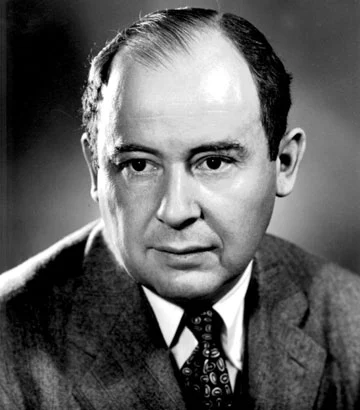
John von Neumann was one of the most wide-ranging scholars of the twentieth century. Born in Budapest in 1903, he contributed to set theory, quantum mechanics, game theory, nuclear physics and computing.
An exceptional mathematical talent
Von Neumann displayed extraordinary memory and speed from an early age. He studied in Budapest, Berlin and Zurich before joining leading European and American mathematical circles.
In 1930 he was invited to Princeton and later became one of the first professors at the Institute for Advanced Study.
From wartime calculation to computers
During the Second World War, he worked on problems requiring enormous amounts of computation. Encountering ENIAC led him to study how electronic machines could become more flexible.
Early computers often required manual rewiring. The stored-program idea placed instructions in memory alongside data.
The EDVAC report
In 1945 the “First Draft of a Report on the EDVAC” circulated under von Neumann’s name. It described a machine with arithmetic, control, memory and input-output units.
The phrase “von Neumann architecture” became standard, but the design grew from collaborative work involving J. Presper Eckert, John Mauchly and others. Von Neumann played a major role in formalising and spreading it.
The IAS computer
At Princeton his team built the Institute for Advanced Study machine. Its organisation inspired several later computers.
He also explored numerical methods, weather prediction, cellular automata and self-reproducing machines.