
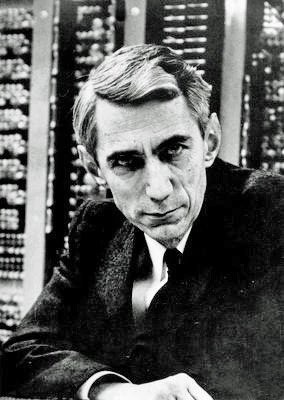
Claude Elwood Shannon is widely regarded as the father of information theory. His work gave telecommunications, computing, data compression and coding a shared mathematical language.
From circuits to logic
Born in Michigan in 1916, Shannon studied electrical engineering and mathematics. At MIT, his master’s thesis showed that relay and switching circuits could be described with Boolean algebra.
The insight offered a systematic way to design control circuits and became a foundation of digital logic.
Bell Labs and communication
At Bell Labs, engineers faced a practical problem: how could messages be transmitted through noisy, limited channels? Shannon realised that the meaning of a message could be separated from its measurable structure.
In 1948 he published “A Mathematical Theory of Communication”. The paper made the bit central and introduced entropy as a measure of uncertainty.
Measuring information
In Shannon’s framework, a message carries more information when it was harder to predict. A certain event tells us little; an unlikely event tells us more.
The theory does not judge whether a message is useful or profound. It measures how much information is needed to represent and transmit it.
Compression, noise and capacity
Shannon established limits for lossless compression and for reliable communication over a noisy channel. These results did not always provide a ready-made engineering recipe, but they defined what was theoretically possible.