Lorenz and Enigma were different problems
During the Second World War, the German armed forces used several encryption systems. These did not produce the same kinds of signals, and breaking them called for different machines and methods.
| System |
Communications involved |
British machine associated with the work |
| Enigma |
Many kinds of military messages, including traffic sent in Morse code |
The electromechanical Bombe helped search for settings. |
| Lorenz SZ40/SZ42 |
High-level communications sent by teleprinter |
Colossus accelerated part of the analysis of the cipher. |
A teleprinter transmits characters as electrical signals and can print them at the receiving end. Lorenz combined those signals with a sequence generated by a mechanism with twelve wheels. At Bletchley Park, the Lorenz system and its traffic were known as Tunny.
That distinction matters: Colossus was not simply a faster Bombe. Our biography of Alan Turing explains his role in the work on Enigma. The electronic design of Colossus was the work of Flowers and his colleagues.
Reconstructing a machine nobody had seen
The British began to understand Lorenz without having a German machine to examine. John Tiltman made a crucial breakthrough by analysing messages encrypted with the same settings. Bill Tutte then reconstructed the system’s logical structure from the patterns he identified.
This made a systematic attack possible, but it did not remove the sheer volume of work. The codebreakers still had to find the settings used for a particular message and make use of the results.
Two sections had complementary roles. The Testery, led by Ralph Tester, worked on deciphering Tunny. The Newmanry, under Max Newman, developed ways to mechanise parts of the search. Newman was not looking for a machine that understood German. He wanted to automate repetitive operations devised by the cryptanalysts.
British Tunny machines, which reproduced the operation of the encryption system, also played a part in producing the decrypted text. Colossus belonged to a chain of work rather than doing everything itself. The museum describes these machines and their different functions.
What Colossus looked for in a message
Encryption changes the appearance of a text. Even so, the Bletchley Park methods could expose useful statistical patterns by combining certain sequences of signals.
Colossus worked through the encrypted characters, combined them with sequences representing hypotheses about the Lorenz wheels, and counted how often a selected condition was met. Depending on the test, an unusually high or low count could point to a promising setting.
One simplified way to picture this is to try different settings on the same data and compare their scores. A result that stands out deserves attention, but it still needs checking. This illustrates the statistical approach without attempting to reproduce the actual attack formulas.
Ben North’s technical account for the Computer Conservation Society describes, in particular, the search for starting positions of the wheels known as chi. The real methods exploited the specific structure of Lorenz; they did not blindly try every possible combination.
From Heath Robinson to Flowers’ electronic design
The difficulty of keeping two tapes in step
An earlier machine, Heath Robinson, entered service in 1943. It compared information on two punched-paper tapes: one represented the intercepted message, while the other carried sequences used in the tests.
Keeping them synchronised was difficult. If their positions drifted apart, the machine would compare the wrong pairs of data. Speed alone was not enough: the alignment had to remain reliable throughout the run.
Flowers proposed generating the required sequences electronically, inside the machine. Only the message tape would still need to be read. This removed the problem of synchronising two tapes, although reading the remaining paper tape still imposed its own constraints.
Lessons from telephone engineering
Flowers worked at the General Post Office Research Station at Dollis Hill, in London. His experience with telephone equipment had familiarised him with electronic valves, also called vacuum tubes.
These components could switch signals without waiting for a mechanical contact to move. That made fast processing possible, but it also raised doubts: could a machine containing so many valves work reliably over long periods?
Drawing on his experience, Flowers argued for a stable design, including avoiding repeated switching on and off. Valves were not infallible. Reliability also depended on the circuits, power supplies, testing and maintenance.
Colossus was a team effort. Harry Fensom and Don Horwood reassembled the first machine at Bletchley Park. Allen Coombs subsequently played an important role in the Mark II development. Flowers led the electronic design, while discussions with the cryptanalysts shaped the requirements and methods.
Inside Colossus: reading, generating sequences and counting
Following the data through the machine makes its operation easier to understand without tracing every circuit.
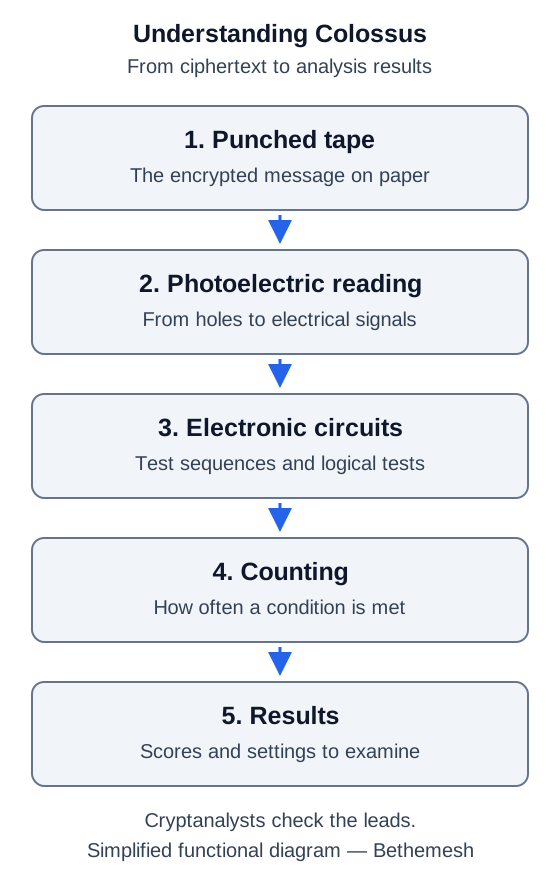
A simplified functional diagram: the arrows show stages of processing, not the exact physical arrangement of the components. Switches and connections determine which tests are performed.
1. Reading the message from punched tape
The encrypted characters were represented on paper tape using five binary positions per character: each position either had a hole or did not. Combinations of these two states encoded the information. The tape therefore held the encrypted message, not the machine’s program.
The tape formed a loop and passed through a photoelectric reader. Light shining through the holes generated electrical signals. It could read about 5,000 characters per second, and the tape also supplied the timing that synchronised the processing.
2. Generating the test sequences
Circuits reproduced the sequences associated with the wheels, using the settings prepared for the search. This allowed the same encrypted characters to be tested against different hypotheses without making a new tape for each one.
Input data and settings thus had different roles: the tape held the material being analysed, while connections and switches determined what the machine tested.
3. Counting and reporting promising results
Logic circuits combined the signals, and counters accumulated the results. Settings and scores considered interesting could be printed for the teams to examine.
Associating each score with the positions tested enabled the cryptanalysts to compare leads and continue their work. Printing connected the electronic calculation to its practical use.
Programming without a stored program
Colossus was prepared using switches, plugs and connections. Operators selected the logical operations and counts appropriate to the current search. There was real flexibility: the machine was not restricted to repeating one unchangeable test.
That programmability was nevertheless tied to its specialised equipment. It did not receive a general sequence of instructions held in memory and changeable like the data in a modern program. It was not designed to switch freely between cryptanalysis, accounting and scientific simulation.
Four ideas need to be kept separate:
| Term |
What it means for Colossus |
| Electronic |
Fast processing relied on valve circuits, but the machine still contained mechanical parts and relays. |
| Digital |
Information was represented by distinct states, including binary values, rather than a continuously varying quantity. |
| Programmable |
Switches and connections allowed different kinds of processing within its intended field. |
| Stored-program |
This does not describe Colossus: it did not hold a general program of instructions in memory. |
The Turing machine, by contrast, is a mathematical model of computation. Both use something described as a tape, but that does not make Colossus a physical implementation of the model. Here, paper carried an encrypted message through a machine built to analyse it.
Mark I and Mark II: development during operational service
The first successful trials took place at Dollis Hill in late 1943. Colossus was then transported to Bletchley Park and reassembled in January 1944.
The Post Office war diary entry for 29 February 1944 states that it was ready for operation on 5 February 1944. The entry goes on to describe daily use and continuing improvements. Separating trials, installation and operational work explains why both 1943 and 1944 appear in accounts of its beginnings.
| Version |
Milestone |
Main development |
| Mark I |
Operational in February 1944; about 1,500 valves |
The first operational machine built to this design. |
| Mark II |
First entered service on 1 June 1944; about 2,400 valves |
More processing capabilities and greater use of parallel processing. |
The valve counts are approximate. Some accounts round the more developed machines up to 2,500. The figures convey the scale of the installation; they should not be read as a count of instructions performed.
Parallel processing allowed several cases to be handled at once. A higher processing rate did not necessarily mean that the paper moved faster. The work also included finding wheel patterns, not just their starting positions: the Post Office diary already mentions this in February 1944. Both methods and equipment evolved to meet cryptanalytic needs.
Ten Colossus machines were in service by the end of the war. The first was not an isolated experiment. It led to a series of machines that were put to practical use.
The women who operated Colossus and the wider workforce
Colossus operators included members of the Women’s Royal Naval Service, known as the Wrens. They made successive runs possible by loading tapes, applying settings, monitoring operation and collecting output. Building the circuits was only one part of making daily message analysis possible.
In her 2015 interview with ABC, Joanna Chorley recalled fitting tapes and checking connections. The National Museum of Computing describes her technical curiosity and her conversations with the engineers. Such recollections bring into view people who disappear from accounts focused only on the designers.
The wider effort also depended on radio interception staff, tape preparation workers, codebreakers, maintenance engineers and those who used the intelligence. A transcription error, a wrong setting or a breakdown could undermine otherwise sound work. Organisation mattered as much as the machine’s speed.
Strategic value followed by decades of secrecy
Reading high-level communications helped the Allies understand their opponents’ intentions and organisation. Colossus accelerated part of that work within a much larger intelligence effort. It would be misleading to credit the machine alone with the success of the Normandy landings or a precise number of months cut from the war.
Secrecy continued after 1945. Eight of the ten machines were destroyed after the war; two were retained for intelligence work into the 1960s, according to GCHQ. Those involved remained bound by their obligations of confidentiality.
The first official information became public in 1975, as the National Museum of Computing notes. Computer historian Brian Randell’s research helped bring recognition to Colossus and its teams. That disclosure did not make all the documentation immediately available: understanding of the project developed gradually.
Secrecy limited its place in public histories and the open circulation of its techniques. It did not erase what its participants had learned. Their experience could be passed on without making every post-war computer a direct descendant of Colossus.
During the 1990s, Tony Sale and a team of volunteers began a reconstruction using fragmentary documentation and personal recollections. The resulting machine is housed at The National Museum of Computing in Block H at Bletchley Park. It is a reconstruction, not an original that has survived intact since the war.
Where does Colossus fit among the first computers?
The phrase “first computer” conceals several different criteria: electronic or electromechanical technology, programmability, special-purpose or general-purpose use, and an external or stored program.
Colossus is generally recognised as the first programmable electronic digital computer, with programmability limited to its particular field. That is more informative than calling it the “first” without qualification. A major achievement was making fast, configurable electronic processing work on a large scale under operational conditions.
Konrad Zuse’s Z3 illustrates a different, electromechanical approach. ENIAC provides another contrast: a general-purpose electronic calculator originally configured through connections and switches. The first stored-program machines, including Baby and EDSAC, illustrate another change: keeping the program’s instructions in memory.
These comparisons concern distinct choices and working machines, not a succession in which each team simply copied its predecessor. Colossus shows how a narrowly defined problem can lead to a major innovation without that machine possessing every feature of a modern computer.
Frequently asked questions
Does 5,000 characters per second mean 5,000 messages?
No. That rate describes reading characters from the tape. A message contains many characters and may require several passes to test different settings. It is not a rate of fully decrypted messages.
Could a statistical result be misleading?
Yes. An interesting score identifies a lead to check, not a certainty. The results have to be considered alongside the other stages of cryptanalytic work. The machine therefore does not replace the teams’ methods or checks.
Can its speed be compared with a modern computer’s?
Only if the task and data are defined precisely and are the same for both machines. Tape-reading speed, the number of tests and the time needed to decrypt a complete message measure different things. A single figure cannot provide a useful comparison.
What is the difference between Colossus and ENIAC?
Colossus was a programmable electronic digital machine specialised in certain cryptanalytic operations; ENIAC was designed for a wider range of numerical calculations. Their equipment and configurations therefore supported different tasks. In their original configurations, neither executed a program of instructions stored in memory. ENIAC later changed: in 1948 it ran instructions encoded in banks of switches, rather than using rewritable memory for the program as the Manchester Baby did.